Best Read It Later Apps in 2026 (Honest Comparison)
Discover the best read it later apps for iPhone in 2026, including current alternatives to the discontinued Pocket service.
The Best Read It Later Apps in 2026: A Comparison That Goes Beyond the Basics
Here is an honest, psychology-informed breakdown of the top save-for-later apps so you can choose the one that actually matches how you consume content — and how you want to.
On This Page
- Why Your Read-It-Later App Might Be Making Things Worse
- The Best Read It Later Apps Compared
- Instapaper Alternatives Worth Considering in 2026
- What Most Article Bookmarking Tools Get Wrong
- Rtriv: A Different Kind of Read Later App for iPhone
- Key Takeaways
- Frequently Asked Questions
Why Your Read-It-Later App Might Be Making Things Worse
Most people searching for the best read it later apps assume the problem is access — that they just need a better place to store content. But the real issue runs deeper than a disorganized bookmarks folder.
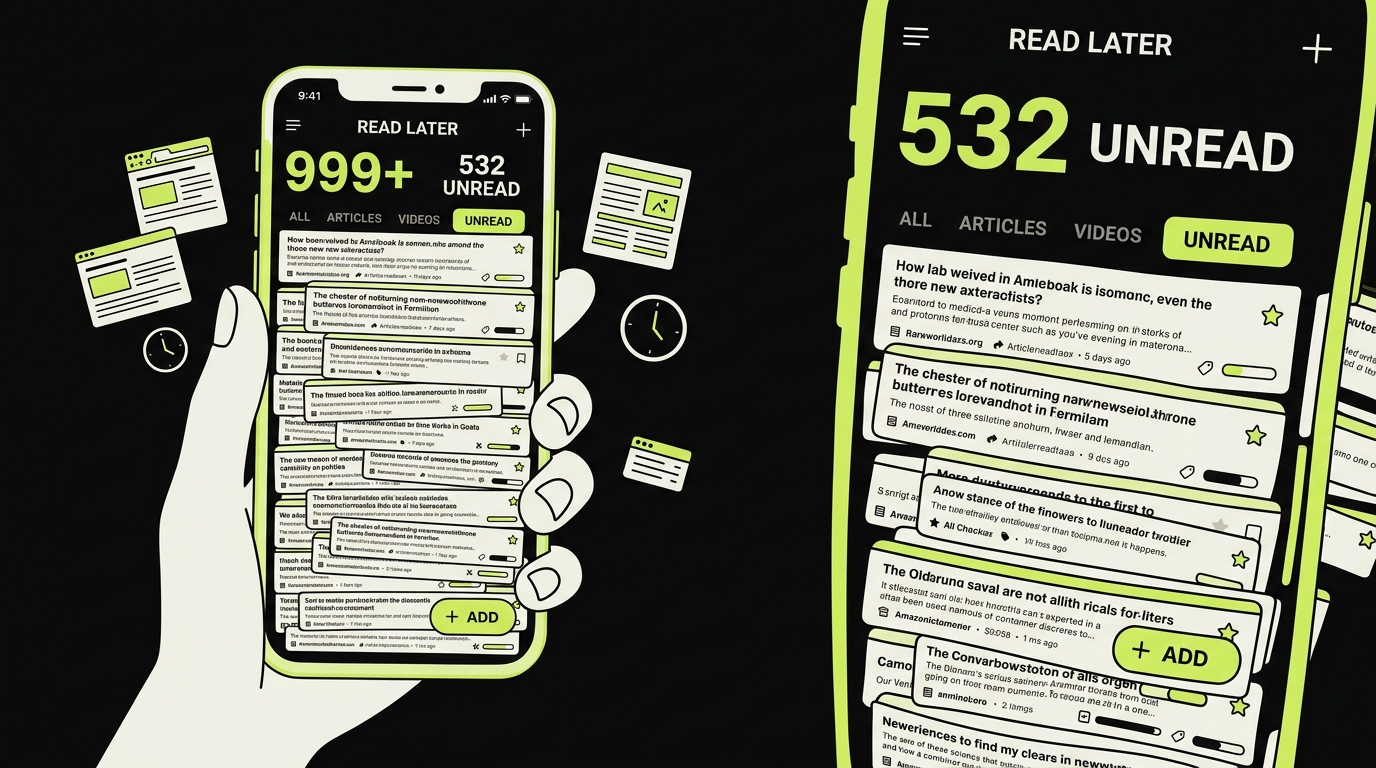
Saving is useful, but a growing queue can become digital clutter when nothing brings you back to it. The important distinction is not how many items an app can hold, but how easily it helps you retrieve and use them.
The result? A growing graveyard of unread articles. A "read later" list that becomes its own source of digital clutter and guilt.
This matters when evaluating save-for-later apps. The question is not only which app has the cleanest interface. It is which app is actually designed with your behavior — not just your content — in mind.
The Best Read It Later Apps Compared
Here is a clear-eyed look at the leading article bookmarking tools available on iPhone in 2026.
Pocket (discontinued)
Mozilla shut Pocket down on July 8, 2025, and its apps and extensions are no longer available. It remains an important reference point for the category, but it is not a viable choice in 2026.
Best for: No new users; compare current alternatives below.
Instapaper
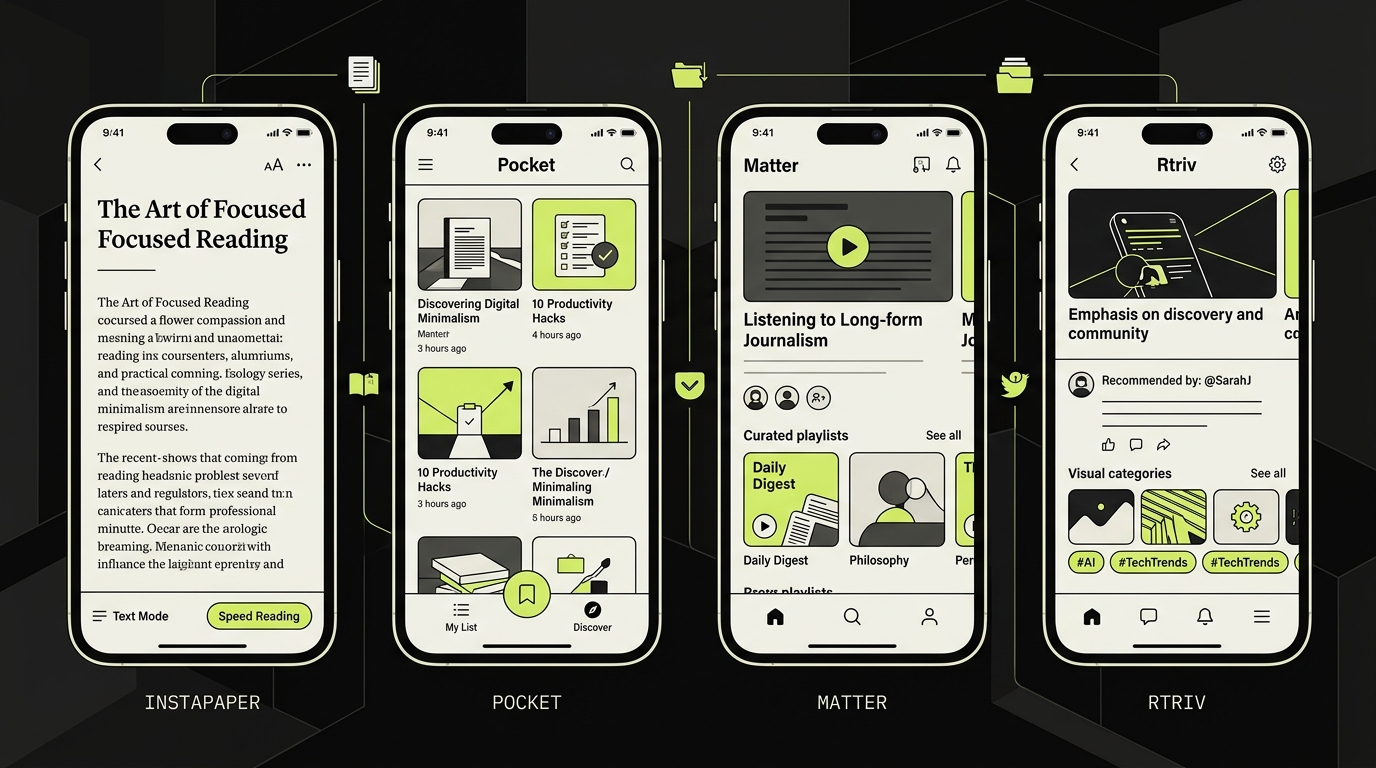
Instapaper is the minimalist's choice. No algorithmic noise, no recommended content — just the articles you saved, stripped of clutter. The typography controls and offline reading make it genuinely pleasant for long-form content.
It has not seen major feature updates in recent years, which is either a strength (stability) or a weakness (stagnation), depending on your perspective.
Best for: Readers who want a calm, distraction-free experience with no social or recommendation layers.
Matter
Matter is the strongest Instapaper alternative for users who consume a lot of newsletters. It pulls in email subscriptions alongside web articles and podcasts, creating a unified reading inbox.
Its social highlighting feature lets you see what others annotated, which can be valuable for communities but distracting for focus-oriented users.
Best for: Newsletter-heavy readers who want one app for web articles, emails, and audio content.
Readwise Reader
Readwise Reader is built for power users. It connects directly to your Readwise highlights database, supports annotations across formats, and includes a robust tagging and filtering system.
The learning curve is steep and the interface can feel overwhelming. But for researchers, writers, or avid note-takers, the depth is unmatched.
Best for: Knowledge workers who already use Readwise and want a deeply integrated reading and annotation workflow.
Instapaper Alternatives Worth Considering in 2026
If you are specifically looking for Instapaper alternatives, you are likely after one of two things: a cleaner reading experience, or something that solves a problem Instapaper never addressed.
The apps above — Matter, Readwise Reader, and Pocket — each solve the content organization problem in different ways. But none of them question the core assumption: that saving more is inherently better.
That assumption is worth challenging. A 2021 study from the University of British Columbia found that reducing smartphone interactions — even briefly — lowered anxiety levels in participants. Simply adding another well-designed bucket for content does not address the compulsive loop that drives excessive saving in the first place.
This is where the comparison gets more interesting.
What Most Article Bookmarking Tools Get Wrong
Every app in the category above shares the same design philosophy: frictionless saving. One tap, and the article disappears into your queue. That is treated as a feature, not a trade-off.
But frictionless saving is precisely what enables the habit loop. You see something on Instagram, feel a spike of interest, tap save, and move on — without ever actually reading or thinking about it. The content accumulates. The backlog grows. The guilt compounds.
This is not a storage problem. It is a behavioral one.
Most save-for-later apps are optimized for volume. They want you to save as much as possible, because a full library is a retained user. But a full library of unread articles is also a digital anxiety machine.
The question worth asking when choosing a read later app for iPhone is not "how easy is it to save?" — it is "does this app help me actually engage with what I save?"
If you want to go deeper on managing the scroll habit itself, the guide on apps to replace doomscrolling covers behavioral tools worth pairing with any reading workflow.
Rtriv: A Different Kind of Read Later App for iPhone
Rtriv was built from a different starting point. Rather than making saving frictionless, it introduces deliberate micro-friction at the moment you want to save content from social media.
Before an article or post is added to your library, Rtriv prompts a brief pause — a moment of intentional reflection. Do you actually want to read this? Or are you just reflexively tapping to escape the discomfort of not knowing?
That single point of friction is more powerful than it sounds. It interrupts the automatic save-and-scroll loop before it completes. Over time, it retrains the habit rather than simply accommodating it.
What Makes Rtriv Different from Other Save-for-Later Apps
- Friction by design. Unlike Pocket or Instapaper, Rtriv treats the moment of saving as an opportunity for mindfulness, not a step to be eliminated.
- Built for social media content. Rtriv is optimized for saving from Instagram, TikTok, and other social platforms — the exact surfaces where compulsive behavior is most triggered.
- Consumption-aware. The app is designed to reduce your backlog, not grow it. The UX prioritizes reading over saving.
Rtriv is not trying to be the biggest content library. It is trying to be the most intentional one.
For users who have already tried the mainstream options and still find themselves with hundreds of unread saves, Rtriv represents a genuinely different approach. You can also read our comparison of Pocket alternatives to see how the broader landscape stacks up.
If your goal is not just to organize your reading but to change how you relate to social content, Rtriv offers a distinct combination of saving and attention controls.
Related reading :
- Best Content Curation Tools in 2026 (Honest Picks)
- Best Bookmark Manager Apps for iPhone 2026
- Best Digital Wellness Apps in 2026: Full Comparison
Key Takeaways
- Most read-it-later apps optimize for frictionless saving — which can reinforce compulsive scrolling rather than reduce it.
- Pocket and Instapaper are solid choices for clean reading; Matter leads for newsletter workflows; Readwise Reader is best for power annotators.
- If you still struggle with unread backlogs or mindless saving, consider a tool such as Rtriv that addresses both retrieval and scrolling behavior.
- Choosing the best read later app for iPhone depends on your goal: content organization, or genuine behavior change.
Frequently Asked Questions
About
Équipe RTRIV
We design RTRIV to turn saved content into decisions, projects and moments that are actually lived.