Digital Detox Challenge: A Realistic 7-Day Plan
Try a structured 7-day digital detox challenge with clear rules, practical alternatives, exceptions, and a plan for returning to your apps.

The Digital Detox Challenge: A 7-Day Plan to Actually Quit Scrolling
Here is everything you need to start, survive, and finish a meaningful digital detox challenge — including the psychology behind why it works and the tools that make it stick.
On This Page
- Why Most Digital Detox Attempts Fail
- What a Real Social Media Detox Challenge Looks Like
- How to Do a 7-Day Digital Detox: Step-by-Step
- The Phone-Free Challenge: Rules, Exceptions, and Edge Cases
- What Happens to Your Brain During a Digital Reset Week
- Key Takeaways
- Frequently Asked Questions
Why Most Digital Detox Attempts Fail
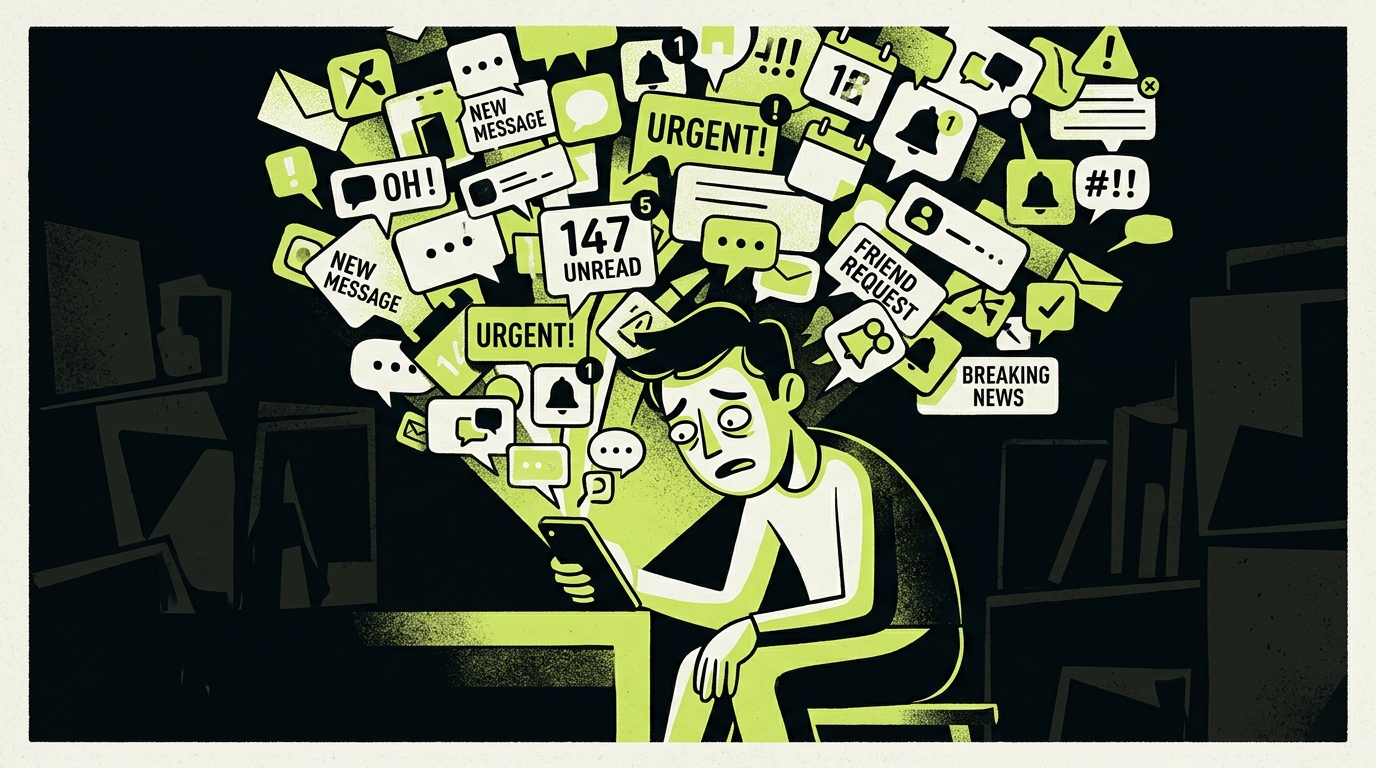
A digital detox challenge sounds simple on paper: put your phone down, step away from social media, reclaim your time. Yet most people who try it give up within 48 hours. If you have ever promised yourself a screen-free challenge on a Sunday night and found yourself doom-scrolling by Monday afternoon, you are not alone — and you are not weak. You are up against a system specifically designed to defeat you.
The core problem is not willpower. It is friction — or rather, the total absence of it. Every social media platform is engineered to have zero barriers between you and the next piece of content. The feed never ends. The notifications never stop. Your thumb moves before your brain even registers what you are doing.
Global averages mix work, messaging, television, and many other activities, so they are a poor personal target. Your own Screen Time or Digital Wellbeing report is a more useful baseline.
What actually breaks the cycle is not a cold-turkey ban — it is redesigning your environment so that mindless behavior becomes harder than intentional behavior. That is the real logic behind a well-structured phone detox plan.
What a Real Social Media Detox Challenge Looks Like
A social media detox challenge is not the same as deleting your accounts or swearing off technology forever. That framing sets people up to fail because it treats a nuanced behavior problem like a binary switch.
A realistic detox challenge has three characteristics: a defined time frame, specific rules you have chosen in advance, and a replacement habit for each behavior you are removing.
The time frame creates a clear experiment. A randomized trial of 154 adults reported better well-being and lower depression and anxiety scores after a one-week social media break. Another one-week randomized study found no causal effect on anxiety or sleep. Seven days is therefore manageable, not a proven neurological threshold.
Specific rules matter because vague intentions collapse under pressure. "Use my phone less" is not a rule. "No social media apps before 10am and after 9pm" is a rule. The more concrete your constraint, the easier it is to enforce — and the easier it is to notice when you are breaking it.
Replacement habits matter because your brain does not just want less stimulation — it wants different stimulation. Boredom is not the enemy of a phone detox plan. It is actually a signal that your brain is beginning to look for deeper sources of meaning. Lean into it.
For people who save content heavily across platforms — articles, recipes, videos — the challenge is not just stopping the scroll. It is figuring out how to keep the valuable content habit without the addictive behavior wrapped around it. This is exactly what Rtriv addresses: it lets you save content intentionally while building in friction that interrupts the mindless part of the loop.
How to Do a 7-Day Digital Detox: Step-by-Step
This is a practical 7 day digital detox framework you can start this week. Each step builds on the previous one — skip ahead and the foundation will not hold.
Before You Start: Prepare Your Environment
-
Audit your current usage. Open your phone's Screen Time or Digital Wellbeing settings and write down your actual daily average. Most people are shocked. This number is your baseline.
-
Define your specific rules. Choose which apps or behaviors you are detoxing from. Full phone-free challenge? Social media only? Decide before day one, not in the moment.
-
Tell one person. Accountability is one of the strongest predictors of habit change. Send a message to a friend or partner tonight.
-
Set up your phone as a tool, not a portal. Delete social media apps from your home screen, or move them into a folder on the last page. Physical distance creates psychological friction.
The 7-Day Digital Reset Week
-
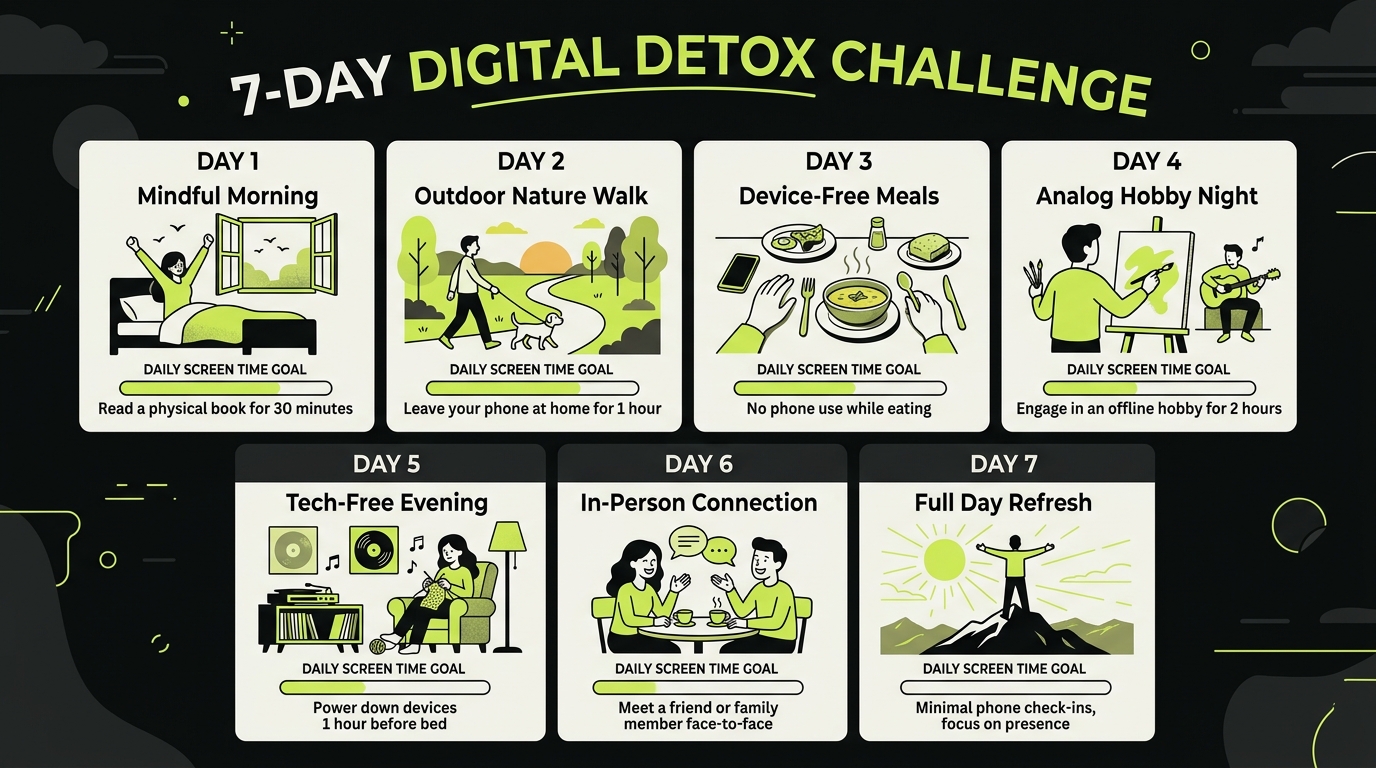
Day 1 — Observe without judgment. Notice every time you reach for your phone automatically. Do not fight the urge yet. Just notice it and log it in a small notebook.
-
Day 2 — Remove the easiest triggers. Turn off all non-essential notifications. Interruptions have variable recovery costs; avoid the misleading claim that every alert costs exactly 23 minutes.
-
Day 3 — Install a replacement habit for your peak scroll times. Most people scroll hardest in the morning and before bed. Replace those windows with something physical: a walk, stretching, reading a paper book.
-
Day 4 — Introduce a phone-free zone. Declare one room in your home (ideally the bedroom) completely screen-free. Buy an alarm clock if needed.
-
Day 5 — Do a social media detox sprint. Delete or log out of every social app for 48 hours. Notice the anxiety in the first few hours — and notice how it fades.
-
Day 6 — Reconnect with analog pleasure. Cook something from a recipe you write by hand. Call someone instead of texting. The goal is reminding your brain that richness exists offline.
-
Day 7 — Review and design your ongoing system. Write down what was hardest, what surprised you, and what one rule you want to keep permanently. The point of a digital detox challenge is not to end at day seven — it is to rebuild your defaults.
The Phone-Free Challenge: Rules, Exceptions, and Edge Cases
The most common reason people abandon a phone free challenge mid-way is that they hit a situation their rules did not anticipate — a work emergency, a social obligation, a family group chat that cannot wait.
The solution is not stricter rules. It is a tiered system.
Tier 1 (Always allowed): Maps, calls, calendar, alarm. These are tools, not feeds.
Tier 2 (Allowed with intention): Messaging apps — but only to respond, never to initiate a scroll. Set a timer for two minutes maximum.
Tier 3 (Locked during the detox): All social feeds, YouTube, news apps, Reddit, any app with an infinite scroll. These are the ones that consume time invisibly.
This tiering removes the all-or-nothing thinking that kills most screen-free challenge attempts. You are not failing because you used Google Maps. You are only failing if you open Instagram while pretending to check the weather.
It is also worth addressing guilt directly. If you slip — and you probably will at least once — the data shows that self-compassion after a lapse predicts better long-term adherence than self-criticism. A stumble on day three does not reset your week. It is information.
You can also check out our digital detox guide for a complementary approach that pairs well with the detox framework above.
What Happens to Your Brain During a Digital Reset Week
The first days may feel unfamiliar because familiar cues no longer lead to the usual action. You may notice boredom, restlessness, relief, or very little change. These experiences are not proof of neurological withdrawal, dopamine-receptor “resetting,” or a fixed recovery timeline.
Use the week to collect evidence about yourself: which cue prompted checking, which boundary helped, what you did with the recovered time, and whether sleep or concentration changed. That record is more useful than expecting a transformation on day three.
What you are really doing in a phone-free challenge is not subtracting something. You are restoring attentional capacity that has been quietly eroding for years.
For a broader look at sustainable unplugging strategies, our Digital detox: the complete guide to unplugging goes deeper into the neuroscience and long-term habits. And if social media is your specific battleground, Social media detox: how to do it and what happens walks through the platform-specific tactics.
The unique angle most articles on this topic miss: the challenge is not just about removing something bad. It is about discovering what you actually want to do with your attention once it belongs to you again. That question is more interesting — and more uncomfortable — than any detox plan.

Research Sources
- PubMed — randomized trial of a one-week social media break
- PubMed — randomized study of social media reduction, anxiety, and sleep
- PubMed — reduction versus abstinence from smartphone use
Key Takeaways
- Seven days is a practical experiment, not a minimum effective dose.
- Friction is the real mechanism: make mindless scrolling harder, not just forbidden.
- Use a tiered rule system (tools vs. feeds) to handle real-life exceptions without abandoning your plan.
- Reactions differ; do not treat discomfort or its absence as a neurological test.
- The goal of a phone detox plan is not to end at day seven, but to redesign your digital defaults permanently.
Frequently Asked Questions
About
Équipe RTRIV
We design RTRIV to turn saved content into decisions, projects and moments that are actually lived.