Social Media Detox: A Practical, Evidence-Based Guide
Plan a realistic social media detox, choose its length, prepare alternatives, and return with healthier boundaries. Evidence and limitations included.
The Complete Social Media Detox Guide: How to Actually Make It Stick
Here is everything you need to understand why a social media detox works, what benefits you can realistically expect, and exactly how to do one without falling back into old patterns within 48 hours.
On This Page
- Why Your Brain Resists a Social Media Break
- The Real Benefits of a Social Media Detox
- How to Do a Social Media Detox: Step-by-Step
- The Friction Method: A Smarter Way to Quit Social Media Temporarily
- What to Do With Your Recovered Time
- Key Takeaways
- Frequently Asked Questions
Why Your Brain Resists a Social Media Break
A social media detox sounds simple in theory. Delete the apps, step away, breathe. But anyone who has tried knows that within hours, something pulls you back — a phantom buzz, a nagging fear of missing out, or just the automatic reach for your phone during a quiet moment.
This is not only a willpower problem. Habit cues, social expectations, and interface design all matter.
Feeds provide an unpredictable sequence of updates, entertainment, and alerts. Combined with easy access and familiar cues, that novelty can turn checking into an automatic routine. Simplistic claims about slot machines or “dopamine depletion” are not needed to explain why a break can feel difficult.
Understanding the mechanism is the first step. The second is having a concrete system — not just motivation.
The Real Benefits of a Social Media Detox
Before diving into the how, it helps to understand what you are actually testing. Research offers useful signals, but not a guarantee that everyone will experience the same benefits.
A 2022 randomized trial of 154 adults found better self-reported well-being and lower depression and anxiety scores after a one-week break than with usual use. However, another randomized one-week study found no evidence of an effect on anxiety or sleep. Different samples, measures, and adherence make the results less universal than many headlines suggest.
Sleep, Focus, and Identity
Sleep may improve if the break removes late-night checking, but it does not improve automatically. Keep the bedtime boundary itself after the detox if that is what helped.
Focus follows quickly. Without constant context-switching between feeds and real tasks, many people rediscover the ability to sit with a single thing for longer than a few minutes. This is not trivial. Deep work, creativity, and meaningful conversation all depend on sustained attention.
There is also a subtler benefit that most articles overlook: identity stabilization. Constant exposure to curated versions of other people's lives distorts your sense of who you are and what you want. A genuine social media break — even a brief one — creates the distance needed to hear your own thoughts again.
Relationships and Real-World Presence
When you quit social media temporarily, you often find that the relationships you thought you were maintaining online were more superficial than you realized. But you also tend to reinvest in the ones that matter — texting a specific person instead of broadcasting to everyone, making plans instead of watching others make theirs.
How to Do a Social Media Detox: Step-by-Step
A successful social media detox requires more than saying "I'll use my phone less." Here is a structured approach that accounts for how habit loops actually work. If use is causing persistent distress or impairment, a break is not a substitute for the options described in our evidence-based guide to social media addiction treatment.
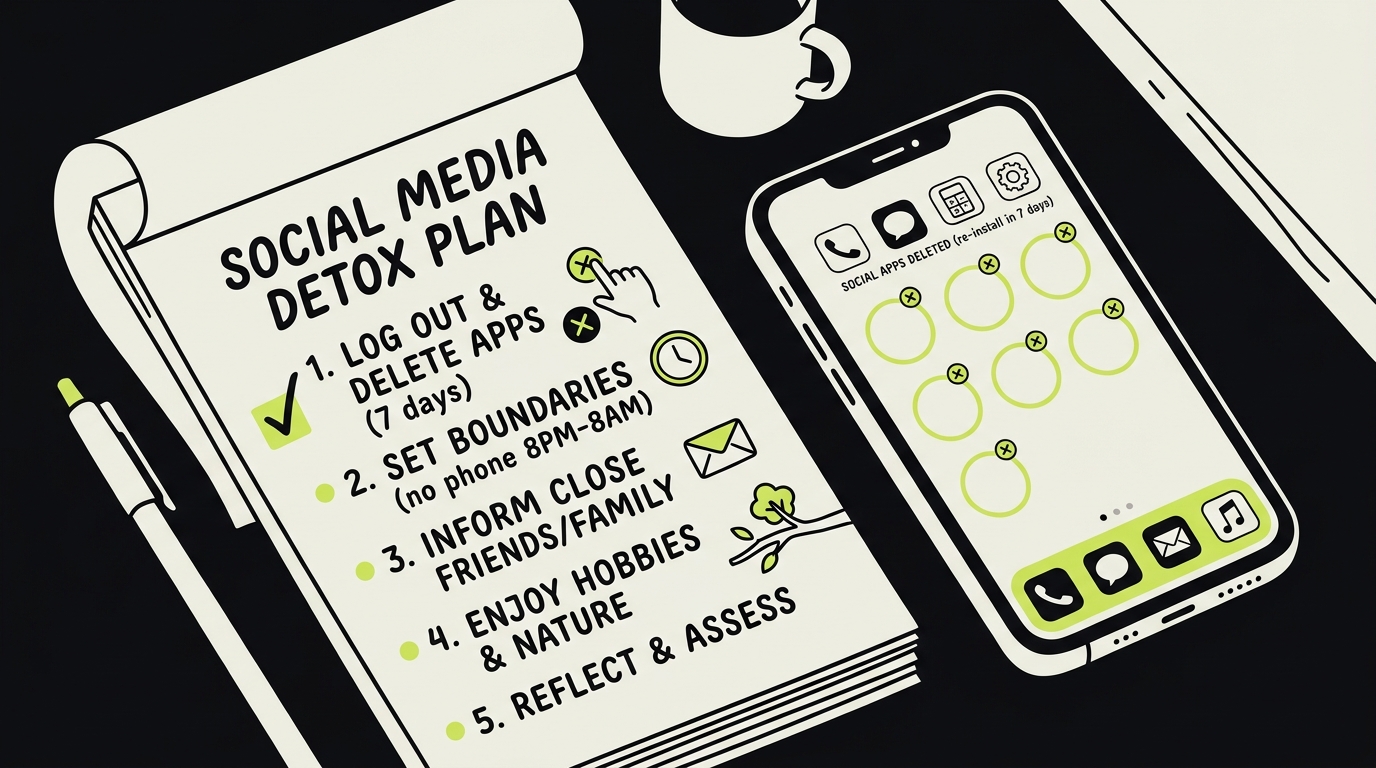
1. Define your scope clearly. Decide which platforms you are stepping away from and for how long. A full platform cleanse is more effective than a partial one, but even limiting to one or two apps is a meaningful start. Write it down.
2. Set your start date and tell someone. Social accountability dramatically increases follow-through. Tell a friend, a partner, or post a note somewhere visible. Externalizing your commitment makes it harder to quietly abandon.
3. Remove the apps from your home screen — or delete them entirely. Friction is everything. If opening Instagram requires navigating three screens, you will catch yourself mid-impulse before completing the action. This is the goal. If you want a deeper break, delete the apps and access accounts only via browser.
4. Block or schedule your access windows. Use your iPhone's Screen Time settings to set daily limits or block apps entirely during certain hours. Consider making the window small enough to feel like an exception, not a habit.
5. Replace the behavior, not just the time. The urge to scroll is often a response to boredom, anxiety, or the need for stimulation. Have a physical replacement ready — a book, a walk, a specific task. Behavioral science consistently shows that substitution outperforms suppression.
6. Save what matters before you go. One of the real fears behind avoiding a social media break is losing useful content — articles, recipes, recommendations. Save them to a dedicated space so the FOMO is removed. (More on this below.)
7. Reflect at the midpoint and after. Check in with yourself halfway through. What do you miss? What don't you? This reflection is what transforms a detox from a temporary pause into lasting behavioral change.
The Friction Method: A Smarter Way to Quit Social Media Temporarily
There is a growing body of thinking — in behavioral design, in UX, in psychology — around intentional friction. The idea is simple: if you make an undesired behavior slightly harder to do, you give your conscious mind a chance to catch up with your impulse.
Most detox advice focuses on removal. The friction method focuses on interruption.
Instead of deleting everything and hoping willpower holds, you introduce small moments of pause into your digital routine. You log out after every session. You move apps to a secondary screen. You save content you want to revisit in a dedicated app rather than staying in the feed to "find it later" — which is often just an excuse to keep scrolling.
This is the approach built into Rtriv, an iOS app designed for exactly this kind of intentional relationship with social content. When you save something from Instagram, TikTok, or any feed with Rtriv, you are gently interrupted — invited to step back rather than keep going. The content is preserved; the compulsion is not rewarded.
It is a meaningful distinction. You are not losing access to what you value. You are just decoupling the act of consuming from the act of mindlessly continuing. For many people, that small break in the loop is enough to start reclaiming genuine control.
If you want to go further, the Digital detox: the complete guide to unplugging covers the broader context — beyond social media into screen time, digital boundaries, and sustainable offline habits.
What to Do With Your Recovered Time
This part matters more than most detox guides acknowledge. If you free up two hours a day and have no idea what to do with them, anxiety fills the void and the relapse happens fast.
Make the List Before You Start
Before your social media break begins, write a list of things you have been saying you want to do but never have time for. The list will probably take you thirty seconds to write. That is revealing.
Reading, cooking, walking without earbuds, calling someone instead of liking their post, learning something physical with your hands — these are not productivity hacks. They are the activities that create the sense of a life well-lived that social media only simulates.
Use the Boredom
This is the counterintuitive part: let yourself be bored. Boredom is not a problem to solve. It is the mental state in which new ideas, genuine desires, and creative impulses surface. Most people have not been truly bored in years because every idle moment is immediately colonized by a feed.
The Digital detox challenge: a 7-day plan that works offers a practical daily structure if you want guidance on how to fill the first week without defaulting back to screens.
Build the After, Not Just the During
The most common mistake in a social network pause is treating it as a finite event with no thought for what comes after. When the detox ends, without new defaults in place, old habits return within days.
Design your re-entry intentionally. Which apps do you want to keep? At what times? With what limits? The goal does not have to be permanent abstinence. Treat the break as an experiment that helps you choose which uses to restore.
For a deeper look at breaking the scroll habit long-term, guide to stop doomscrolling walks through the psychological mechanisms and practical tools beyond the detox window itself.
Research Sources
- PubMed — randomized trial of a one-week social media break
- PubMed — randomized study of social media reduction, anxiety, and sleep
- PubMed — experimental study of 14-day social media abstinence
Key Takeaways
- A social media detox works best when paired with intentional friction, not just willpower — design your environment before you rely on motivation.
- Trials report mixed outcomes: some find short-term benefits, while others find no clear change in anxiety or sleep.
- Replace deleted behaviors with specific alternatives before you start — substitution is more effective than suppression.
- Use the detox to design your re-entry intentionally: decide in advance which platforms, at what times, and with what friction built in.
- Saving content you value before stepping back removes the fear of missing out that drives most relapses.
Frequently Asked Questions
About
Équipe RTRIV
We design RTRIV to turn saved content into decisions, projects and moments that are actually lived.