Phone Addiction Treatment: Evidence and Practical Options
There is no single approved phone addiction treatment. Compare self-management, therapy, environmental changes, and reasons to seek professional help.

Phone addiction treatment: choosing the right level of support
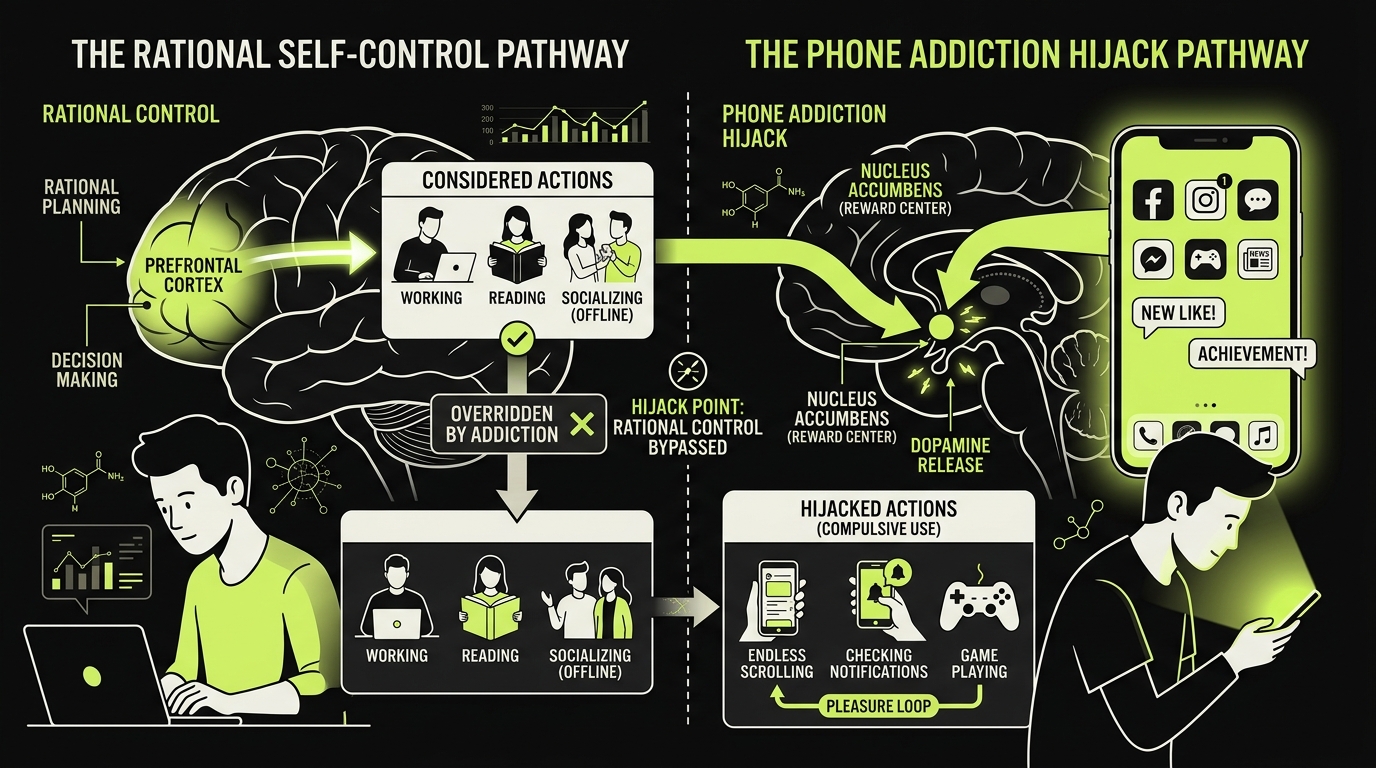
There is no single approved phone addiction treatment and no universally accepted standalone diagnosis for smartphone addiction. Researchers often use “problematic smartphone use” to describe difficulty controlling a particular pattern despite meaningful consequences.
Treatment should therefore start with the behavior causing harm—not with a promise to eliminate the device or “reset dopamine.” Calls, navigation, work, accessibility, games, news, and social feeds serve different functions. When feeds are the specific source of impairment, use the more targeted guide to social media addiction treatment.
Start with a functional assessment
For one ordinary week, record:
- the app or activity involved;
- what happened immediately before checking;
- whether the use was planned;
- how long it displaced sleep or another task;
- the consequence that matters to you.
This distinguishes high but useful use from a narrower loss-of-control pattern. Total screen time is context, not a diagnosis.
Self-directed options
Target one behavior
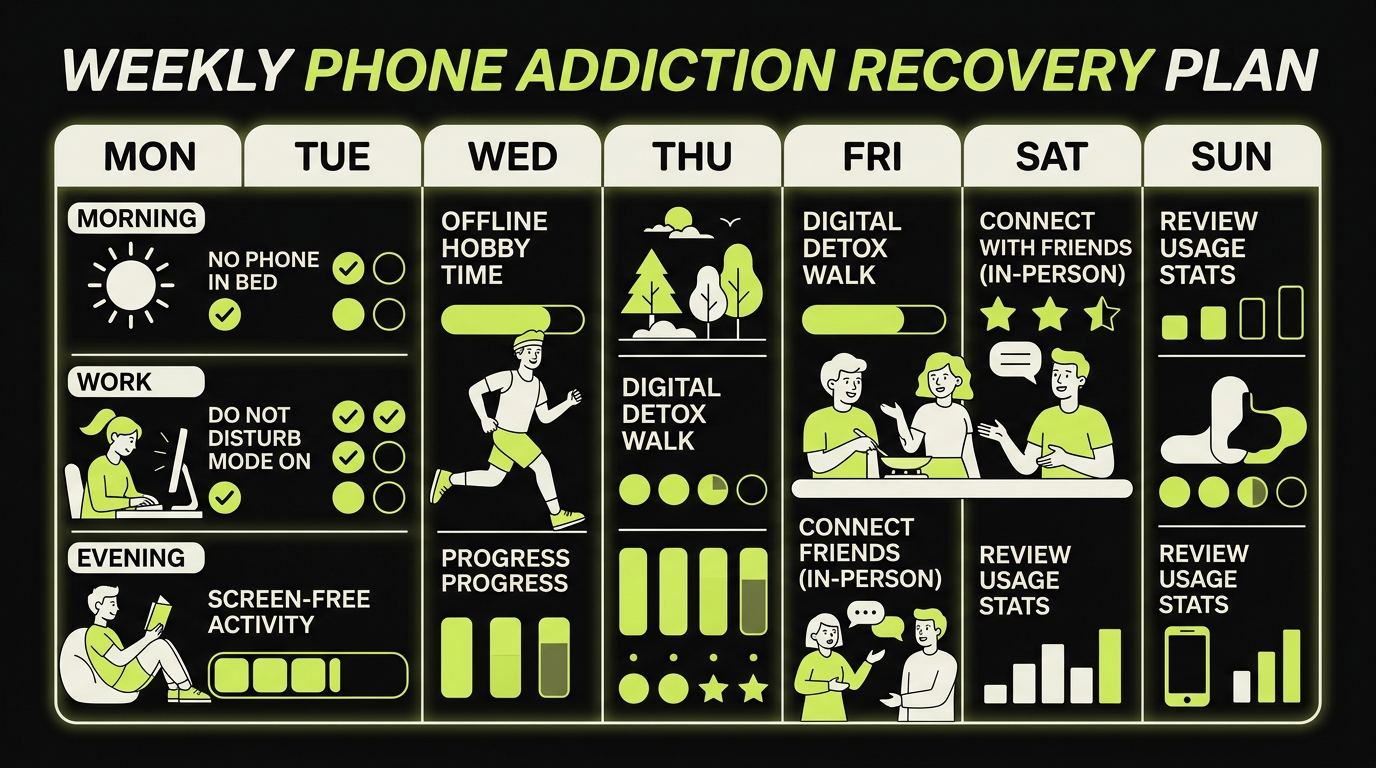
Choose a concrete rule such as “no social feed in bed” or “news checked twice a day.” Broad goals like “use my phone less” are difficult to evaluate.
Change the environment
Disable nonessential notifications, remove the target app from the home screen, log out, or leave the phone outside a focus session. These changes create a decision point without making essential functions unavailable. If waking is the main trigger, use the targeted plan for stopping first-thing morning phone checks.
Replace the function
If checking provides connection, contact someone directly. If it avoids a difficult task, write the smallest next step. If it fills transitions, prepare a short offline activity. Replacement is more specific than generic restriction.
Review outcomes weekly
Track bedtime, completed tasks, conflicts, unplanned pickups, and mood. A lower total is useful only if the outcome you care about improves.
Rtriv can help separate saving useful social content from continuing in a feed, but it should be presented as one behavior-design tool—not as clinical therapy.
What can professional treatment include?
A clinician may first assess sleep, anxiety, depression, ADHD, substance use, or other factors that contribute to repeated checking. Treating an underlying condition can be more appropriate than focusing on the phone alone.
Psychological interventions may use cognitive-behavioral techniques, motivational work, trigger monitoring, or skills for tolerating urges and managing emotions. However, a 2024 meta-review found inconsistent definitions and measures across “electronic addiction” studies. Psychological and exercise-based interventions showed some short-term benefit, but no treatment was clearly superior overall.
That means CBT should not be advertised as a guaranteed or uniquely proven cure for phone addiction. The appropriate approach depends on the person's difficulties, goals, and any coexisting condition.
Reduction, friction, or a digital detox?
| Approach | Best used for | Main limitation |
|---|---|---|
| Targeted reduction | A specific harmful routine | Requires a clear baseline |
| Environmental friction | Automatic checking cues | Limits can be bypassed |
| Time-limited detox | Learning which uses are optional | Benefits may not persist after return |
| Professional support | Significant distress or impairment | Access and fit vary |
A break can be informative, but discomfort during it does not prove biological withdrawal. See phone withdrawal: what evidence supports and the broader digital detox guide.
When to seek professional help
Consider a qualified mental-health professional when phone use repeatedly disrupts sleep, work, education, relationships, finances, or safety; when attempts to reduce create substantial distress; or when low mood, anxiety, impulsivity, or attention problems are also present.
Seek urgent help for suicidal thoughts, severe confusion, or immediate danger. Do not assume these symptoms are caused by a phone detox.
If attention difficulties are central, ADHD and phone addiction explains the overlap without treating phone use as an ADHD test.
Research sources
- PubMed — meta-review of electronic-addiction screening and treatment
- Systematic review of problematic smartphone-use scales
- PubMed — problematic smartphone use and mental-health associations
Key takeaways
Effective support targets a specific behavior and its consequences. Start with measurement, change one cue, prepare a replacement, and review the outcome. Professional care is appropriate when impairment is substantial or another condition may be involved; no universal recovery timeline or single best therapy has been established.
Frequently asked questions
Is there an approved treatment for phone addiction?
No single standard treatment exists. Options range from targeted self-management to psychotherapy and care for related conditions.
How long does recovery take?
There is no validated universal timeline. Measure improved control and functioning instead of expecting habit “rewiring” by a fixed date.
When should I seek professional help?
Seek support when use causes substantial or persistent harm, safety problems, or distress, or when another mental-health or sleep condition may contribute.
Frequently Asked Questions
About
Équipe RTRIV
We design RTRIV to turn saved content into decisions, projects and moments that are actually lived.