Phone Addiction Withdrawal: Symptoms, Evidence, and What Helps
Irritability or repeated checking can occur when cutting phone use, but there is no fixed withdrawal timeline. Learn what evidence supports and what to do.

Phone addiction withdrawal symptoms: what the evidence actually says
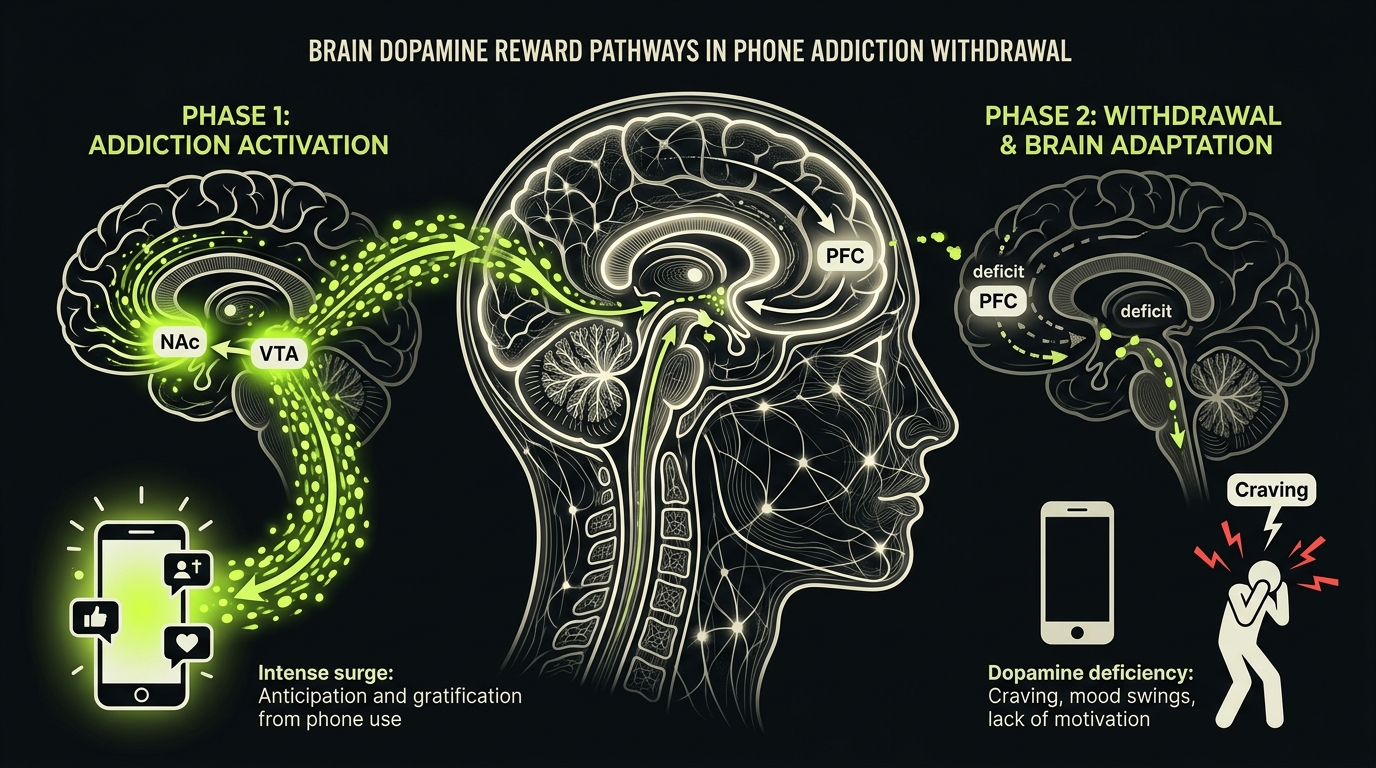
People who cut back on habitual phone use sometimes report irritability, restlessness, boredom, anxiety, or a strong urge to check. These experiences may feel like withdrawal, but phone withdrawal is not a standard medical diagnosis, and research has not established a universal sequence in which symptoms peak at 24–72 hours and disappear within two weeks.
“Problematic smartphone use” is the more careful research term. It focuses on difficulty controlling use and meaningful consequences rather than treating every frequent user as addicted.
What may happen when you cut back
Possible experiences include:
- reaching for the phone automatically;
- worrying about missed messages;
- irritability when access is blocked;
- boredom during familiar checking moments;
- difficulty deciding what to do next;
- noticing phantom vibrations.
These signs are not proof that dopamine receptors are “resetting.” They can reflect learned cues, social expectations, uncertainty, or the removal of a familiar coping behavior. Headache, severe anxiety, persistent low mood, or sleep problems also have many possible causes and should not automatically be labelled phone withdrawal.
What research does—and does not—show
Reviews find associations between problematic smartphone use and depression, anxiety, stress, and poor sleep. Most underlying studies are observational, so they cannot establish which factor caused the other.
A systematic review of smartphone-use scales found that withdrawal is inconsistently defined and that evidence for the loss of control, tolerance, and withdrawal patterns seen in substance disorders is limited. Applying a substance-withdrawal timeline to phones therefore overstates current knowledge.
Phantom vibration is a documented perception, but it is not specific to “detox” and does not establish addiction. Likewise, discomfort after removing a routine does not necessarily mean complete abstinence is medically required.
A safer way to reduce problematic use
Define the behavior, not the device
Choose a target such as late-night scrolling, repeated news checking, or social feeds during work. Keep essential calls, maps, authentication, accessibility tools, and supportive conversations available.
Measure a baseline
Use the device report for several ordinary days. Record pickups, the most-used apps, bedtime use, and the situations in which checking creates a real cost. Total screen time alone can confuse useful and unwanted use.
Change one cue
Disable one notification category, move one app, or leave the phone outside one focused session. A small test reveals whether the cue matters without creating an all-or-nothing challenge.
Prepare a replacement
If checking fills a transition, decide what replaces it: a written next-action list, a short walk, music, or contacting one person directly. The alternative should match the need rather than merely occupy time. When waking is the recurring cue, use this seven-day plan for first-thing morning phone checking.
Review the result
After a week, compare sleep, completed tasks, mood, and unplanned pickups. Keep boundaries that helped. Revise those that only created inconvenience or isolation.
When self-management is not enough
Seek professional support when phone use repeatedly disrupts sleep, work, education, relationships, finances, or safety, or when attempts to reduce it cause substantial distress. A clinician can also assess anxiety, depression, ADHD, sleep problems, or other factors that may be driving the behavior.
There is no single best treatment established for “phone addiction.” A 2024 review found inconsistency in definitions, screening, and interventions; psychological and exercise-based approaches showed some short-term benefit, but no approach was clearly superior overall. See phone addiction treatment options for a decision-focused overview.
If ADHD affects your pattern, read ADHD and phone use. For a time-limited experiment rather than a clinical framing, use the digital detox guide.
Research sources
- Systematic review of problematic smartphone-use scales
- PubMed — problematic smartphone use, anxiety, and depression
- PubMed — meta-review of screening and treatment for electronic addictions
Key takeaways
Reducing phone use can expose strong habits and uncomfortable emotions, but there is no validated phone-withdrawal timeline or dopamine-reset schedule. Target the behavior causing harm, preserve essential functions, measure the effect, and seek support when distress or impairment is substantial.
Frequently asked questions
Can reducing phone use cause withdrawal symptoms?
Some people report urges, irritability, restlessness, or boredom. The evidence does not support a universal symptom list or medical withdrawal timeline.
How long does phone withdrawal last?
There is no established duration. Experiences vary, and persistent or severe symptoms deserve assessment rather than being attributed automatically to a phone detox.
Should I stop using my phone completely?
Usually the useful goal is targeted reduction while preserving essential functions. Complete abstinence is neither practical nor proven necessary for everyone.
Frequently Asked Questions
About
Équipe RTRIV
We design RTRIV to turn saved content into decisions, projects and moments that are actually lived.