7 Best Readwise Alternatives in 2026 (Free & Paid)
Compare 7 Readwise alternatives for highlights, read-later, self-hosting and social saves—including free options and clear picks by use case.

7 Best Readwise Alternatives in 2026: Free and Paid Options Compared
The best Readwise alternative depends on what you are replacing. Choose Matter for a polished reading queue, Obsidian for local Markdown and control, Raindrop.io for broad bookmark organization, Wallabag for self-hosting, or Rtriv when most of your useful saves start on social media. Readwise remains the strongest option here for native highlight resurfacing and Daily Review.
Quick comparison
| Alternative | Best for | Free option | Main trade-off |
|---|---|---|---|
| Matter | Articles and newsletters | Limited | Less suited to custom knowledge systems |
| Obsidian | Local notes and Markdown ownership | Yes | You design the review workflow |
| Notion | Flexible databases and team workspaces | Yes | Requires ongoing structure and maintenance |
| Raindrop.io | Bookmarks, media and collections | Yes | No Readwise-style spaced review |
| Wallabag | Self-hosted read-later control | Self-hosted | Setup and maintenance |
| Instapaper | Simple distraction-free reading | Yes | Lighter knowledge-management features |
| Rtriv | Structured social and web saves on iPhone | Yes | Not a Kindle-highlight replacement |
On This Page
- Why people look for a Readwise alternative
- The best Readwise alternatives compared
- Free alternatives to Readwise worth considering
- When Rtriv is the right alternative
- How to choose the right reading companion app for you
- Key Takeaways
- FAQ
Why People Look for a Readwise Alternative
Readwise is strong at resurfacing highlights from books and articles. But it is a paid product after its trial: the official pricing page currently lists $9.99 per month when billed annually or $12.99 when billed monthly. That can be more than a casual saver needs, especially when the backlog lives in social feeds rather than a highlight library.
Most people saving content aren't power readers with 500 Kindle highlights. They're scrolling Instagram, TikTok, or X, tapping "save" on dozens of posts, and never returning to them. That behavior isn't a highlight management problem. It's an attention problem.
The search for Readwise substitutes has accelerated because users are increasingly aware that organizing their saves doesn't fix their relationship with their feed. They want tools that are lighter, cheaper, or simply better matched to how they actually consume content in 2026.
Understanding what you need from a reading companion app — passive archiving, active review, or genuine behavioral change — is the real starting point for this comparison.

The Best Readwise Alternatives Compared
1. Obsidian — best free option for local ownership
Obsidian is the strongest choice for knowledge workers who want full control over their notes. It stores data locally in plain-text Markdown files, requires no account for the core app and is free for personal and commercial use. Optional paid services cover first-party sync and publishing.
The upside is data ownership and a workflow you can shape over time. The downside is that Obsidian does not reproduce Readwise's import and Daily Review system by default: you must decide how highlights enter the vault and how they resurface. It can remain simple, but advanced automation adds setup.
2. Notion — best for flexible databases
Notion functions as a capable highlight management tool when combined with its web clipper and a few database templates. You can create a reading list, tag by source, and build filtered views that surface content to review on a schedule.
It's free at the personal tier, which makes it one of the more accessible free alternatives to Readwise. But it requires you to design and maintain your own system, and it adds no friction to the saving behavior that got you into information overload to begin with. Notion organizes the chaos — it doesn't reduce it.
3. Matter — best dedicated reading experience
Matter is perhaps the most polished dedicated reading companion app in this comparison. It ingests newsletters, articles, and RSS feeds beautifully, offers text-to-speech for multitasking, and has a clean highlight and annotation layer.
If your content diet is primarily long-form articles and newsletters rather than social-media posts, Matter is worth evaluating. Check its current feature and pricing pages before choosing because plans can change.
4. Raindrop.io — best for mixed bookmarks
Raindrop.io is broader than a read-later app. It organizes articles, videos, images and links into searchable collections, making it useful when your archive contains more than prose. Its free tier covers the core bookmark workflow.
The trade-off is conceptual: Raindrop.io helps you keep and retrieve sources, but it does not replicate Readwise's spaced highlight review. Choose it for collection management, not memorization.
5. Wallabag — best self-hosted alternative
Wallabag is an open-source read-later service that can be self-hosted. It is a strong fit when control over hosting and article storage matters more than polished onboarding.
Self-hosting is also its cost: installation, updates and backups become your responsibility. It replaces the reading queue more directly than the highlight-learning loop.
6. Instapaper — best for simplicity
Instapaper is one of the oldest players in the read-later space, and it still earns its place. It strips articles down to clean text, supports highlights, and syncs across devices. The free tier is usable; the premium plan adds full-text search and unlimited notes.
It does not offer Readwise's Daily Review, so it is closer to a focused reading queue than an active retention system. If you're looking for a no-fuss, lightweight alternative, our deep dive on Best Instapaper alternatives in 2026 covers how it stacks up in the broader landscape.
Pocket (discontinued)
Mozilla shut Pocket down in July 2025, and its apps and extensions are no longer available. Former Pocket users should compare active replacements in our Pocket alternatives guide.
7. Rtriv — best for social-media saves on iPhone
Rtriv is not a clone of Reader or Readwise. It is designed for supported social posts and web links that you want to turn into a searchable save, collection or concrete action. That distinction matters: choose it for recipes, places, recommendations and projects encountered in feeds—not for Kindle highlight review.
Free Alternatives to Readwise Worth Considering
The demand for free alternatives to Readwise is real and growing. Readwise's pricing model works well for voracious readers who can justify the cost through daily review sessions. For everyone else, the math doesn't add up.
Here's a quick breakdown of what you can get without paying:
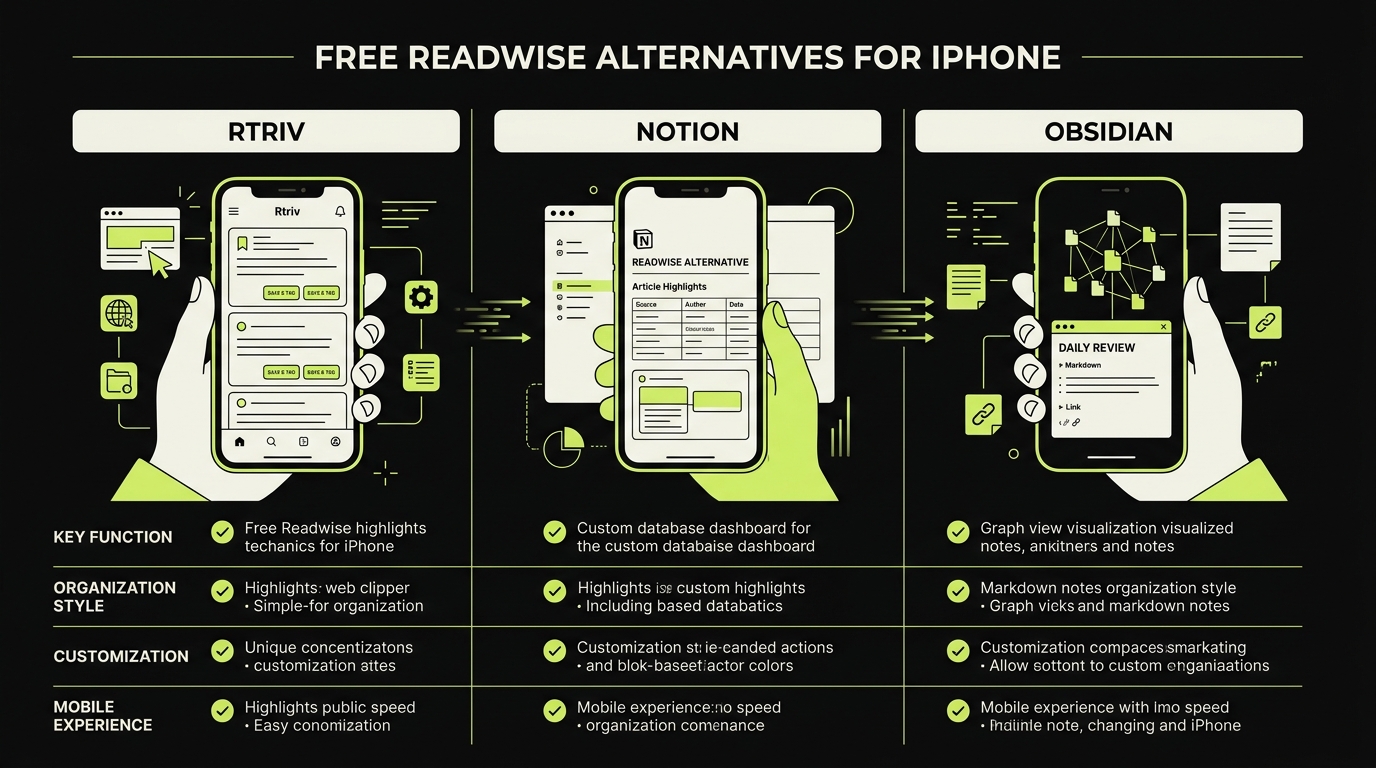
Notion (free tier) gives you an unlimited personal workspace. With a good template, it becomes a functional highlight management system. Requires manual effort but costs nothing.
Obsidian (free, local) is the most powerful free option for knowledge management. The learning curve is steep, but the payoff for committed users is unmatched.
Rtriv (iPhone) is designed for people who save useful social-media content and web links. It turns supported content into a searchable library and can extract useful structure such as summaries, ingredients or steps.
Logseq is an open-source, graph-based alternative for users who want Obsidian-like power with a different UX philosophy. Also completely free.
Free does not mean equivalent. Compare the entire workflow: supported inputs, offline access, export format, search, review and the cost of maintaining the system yourself. A free notes app can replace storage without replacing Readwise's automatic imports or resurfacing.
When Rtriv is—and is not—the right alternative
Most Readwise comparisons focus on highlights, review and export. Rtriv serves a different input stream: useful posts and links found while browsing or scrolling.
Share supported content through the iOS share sheet and RTRIV centralizes it in a searchable library and collections. Depending on the source, it can extract a title, summary, transcript, ingredients or steps. The result can become a recipe to cook, a place to revisit, a project to try or a recommendation to act on.
What Rtriv does differently
- Structured social-media saves. Supported posts and web links become searchable information rather than isolated bookmarks.
- Collections and retrieval. Saves live in one library instead of remaining split across platform-specific favorites.
- From content to action. Extracted steps, ingredients and reminders help turn saved inspiration into something concrete.
- Configurable attention controls. Users can add friction or blocking rules before selected apps open and set daily intentions or quotas.
If you're looking at this category through a second-brain lens, our guide on Best second brain apps in 2026: top picks for iPhone puts Rtriv in context alongside other tools in that broader ecosystem.
Rtriv will not replace Readwise for someone who wants spaced review of Kindle highlights. It is the more relevant option when your backlog is primarily made of social posts and web links that you want to organize and use. You can explore it at rtriv.io.
How to Choose the Right Reading Companion App for You
The right Readwise substitute depends entirely on where your content comes from and what you want to do with it.
If most of your saves come from Kindle and long-form articles, Readwise Reader or Matter are the strongest options. The spaced-repetition review system in Readwise is genuinely excellent for retention, and there's no equivalent in any free tool at that level of polish.
If you want a free alternative and don't mind building your own system, Notion or Obsidian give you the infrastructure. You'll spend time on setup, but you'll own the result completely and pay nothing.
If your content diet is dominated by social media, Rtriv is the closest match here because it combines structured saving with optional attention controls.
If you want simplicity above all else, Matter or Instapaper covers common read-later use cases with minimal setup.
The honest answer is that switching tools only helps when the replacement matches the real bottleneck. If you never review highlights, choose a stronger review habit before migrating an archive. If the material is scattered across social platforms, improve capture and retrieval instead.
Related reading :
Key Takeaways
- Readwise is excellent for book and article highlights with spaced repetition — but its price and scope don't fit every user's needs in 2026.
- The best free alternatives to Readwise include Obsidian for local Markdown, Notion for databases and Wallabag for a self-hosted reading queue.
- Rtriv is not a Readwise clone: it is better suited to structured social-media saves and actions than to ebook-highlight review.
- Choose your tool based on where your content comes from: long-form articles and books favor Matter or Readwise Reader; social media-heavy diets favor Rtriv.
- Behavioral research confirms that habitual scrolling reduces intentional decision-making — apps that address the behavior, not just the archive, offer a meaningfully different value proposition.
Sources checked
Frequently Asked Questions
About
Équipe RTRIV
We design RTRIV to turn saved content into decisions, projects and moments that are actually lived.