7 Best Second Brain Apps in 2026 (Compared)
Compare 7 second brain apps for notes, research, reading and social saves. See the best choice for iPhone, privacy, AI and connected knowledge.
7 Best Second Brain Apps in 2026: An Honest Comparison
There is no universal best second brain app. Notion is best for flexible databases and collaboration, Obsidian for local Markdown and linked notes, Capacities for object-based knowledge, Readwise Reader for reading and highlights, and Rtriv for structured saves from social media and web links on iPhone.
Second brain apps at a glance
| App | Best for | Data model | Main trade-off |
|---|---|---|---|
| Notion | Databases, projects and collaboration | Cloud workspace | Systems can become complex |
| Obsidian | Private local notes and links | Local Markdown files | Sync is an optional paid service |
| Capacities | People, books, projects and other objects | Connected objects | Advanced workflows take learning |
| Readwise Reader | Articles, PDFs and highlight review | Reading library | Paid after the trial |
| Apple Notes | Fast capture in the Apple ecosystem | Notes and folders | Fewer advanced PKM structures |
| Mem | AI-assisted text retrieval | AI-organized workspace | Best suited to text-heavy capture |
| Rtriv | Social and web saves that lead to action | Structured library and collections | iPhone-focused; not a full writing app |
On This Page
- What "second brain" actually means in 2026
- The best second brain apps compared
- What most second brain app reviews get wrong
- How Rtriv connects capture to action
- How to choose the right personal knowledge base for your brain
- Key Takeaways
- FAQ
What "Second Brain" Actually Means in 2026
The phrase "second brain app" gets used loosely — sometimes for note-taking tools, sometimes for AI summarizers, sometimes for read-later apps. But the concept has a more specific origin. Productivity author Tiago Forte popularized the framework: a second brain is a dedicated external memory system designed to capture ideas, save resources, and connect knowledge so your biological brain doesn't have to hold everything at once.
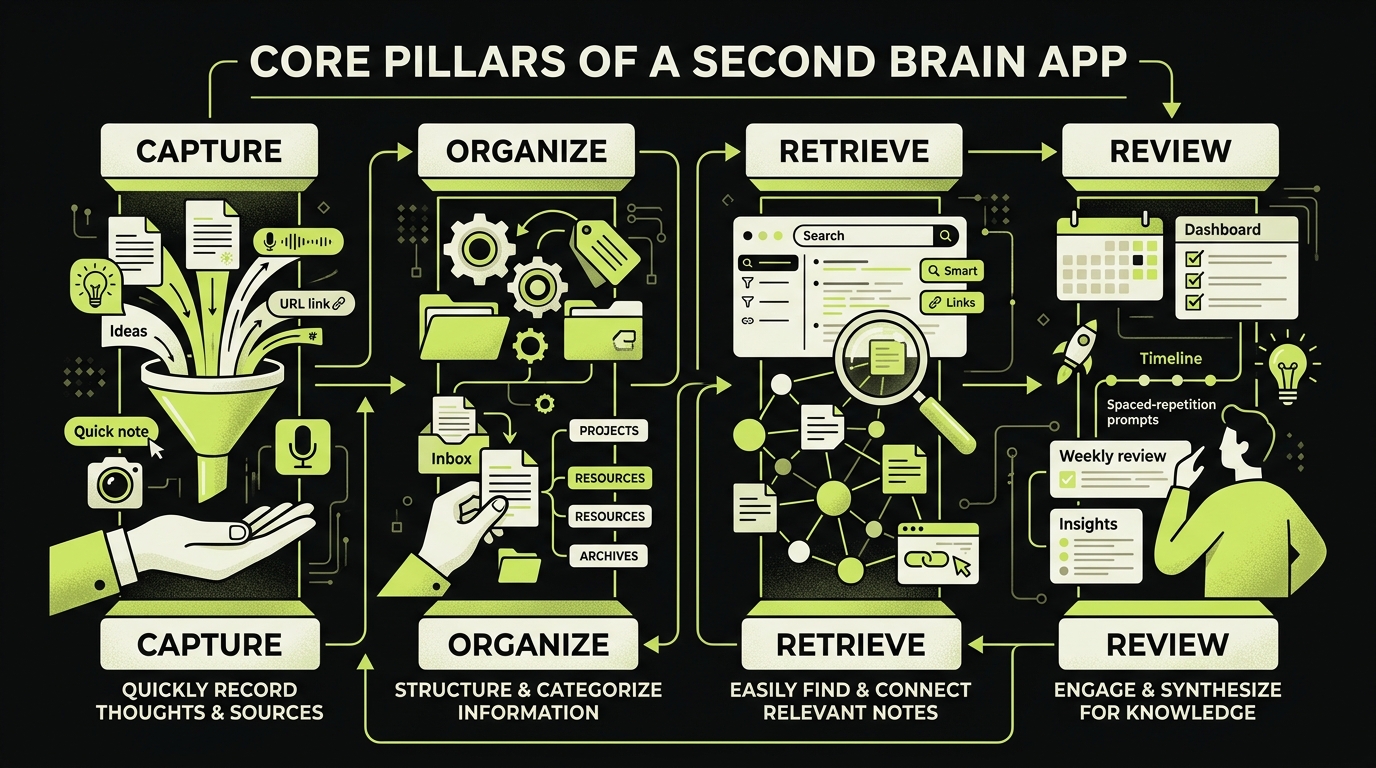
In practice, a true second brain app should do more than store notes. It should help you capture content from wherever you encounter it, organize that content in a way that mirrors how you think, and surface it again when it's actually useful. That's a high bar — and most tools only clear part of it.
The category has exploded in the last two years. AI-powered features now promise to tag, summarize, and connect notes automatically. The market is crowded, and the differences between tools matter more than ever. Understanding what you actually need from a personal knowledge base is the first step before committing to any platform.
The Best Second Brain Apps Compared
1. Notion — best for flexible workspaces
Notion's strength is flexibility: you can build databases, wikis, project trackers, and reading lists in one workspace. Its current AI features can summarize, search and work with workspace context; full access depends on the plan, while Free and Plus workspaces receive limited trial usage.
The weakness is the setup cost. Notion is only as good as the system you build inside it. Most users spend more time architecting their second brain than actually using it. For people who love structure and have the patience to design their workflow, it's powerful. For everyone else, it becomes an abandoned graveyard of half-finished pages.
2. Obsidian — best for local notes and privacy
Obsidian is the tool of choice for users who think in connections. Notes link to each other, and a graph view visualizes the relationships between ideas. It's entirely local-first, which appeals to privacy-conscious users.
Obsidian works without plugins or custom CSS, and the core app is free. Its local Markdown model is a clear advantage for portability and privacy. The learning curve appears when you add complex metadata, community plugins or a highly customized review system—not when you simply write and link notes.
3. Capacities — best object-based second brain
Capacities organizes knowledge as objects such as people, books, meetings and projects rather than as a hierarchy of files. Daily notes provide a low-friction inbox, while backlinks and object properties create structure as the system grows. The core plan is free, with advanced tasks and AI features on paid plans.
This approach is easier to navigate than a blank database for some users, but it still asks you to adopt its object model. Choose Capacities if connected entities make more sense to you than folders or raw Markdown files.
4. Readwise Reader — best for reading retention
Readwise solves a specific problem: you read a lot, but retain almost none of it. Its spaced-repetition system resurfaces highlights from books, articles, and newsletters at intervals optimized for memory. For avid readers, it's genuinely one of the best second brain apps available.
The limitation is scope. Readwise is excellent at what it does, but it's oriented around long-form reading. It doesn't address the dominant way most people actually consume content in 2026 — short-form social media posts, videos, and threads. If you want to explore Best Readwise alternatives in 2026, the options are wider than most people expect.
5. Apple Notes — best zero-setup option for Apple users
Apple Notes is often omitted from second-brain comparisons because it looks basic. That simplicity is the advantage: quick notes, document scans, tags, links and search are already available across Apple devices, with almost no setup.
It is less suitable for elaborate knowledge graphs or cross-platform workflows. But a modest system you consistently use can outperform a sophisticated system you abandon.
6. Mem — best for AI-assisted retrieval
Mem positions itself as the AI second brain app: notes are automatically organized, tagged, and connected without any manual effort. The pitch is zero friction on the capture side.
In practice, Mem works best for users who generate a lot of text-based notes and want AI to handle the taxonomy. The auto-organization is impressive. But passive capture without intentional engagement tends to produce a large, hard-to-navigate archive rather than a living knowledge system.
7. Rtriv — best for actionable social saves on iPhone
Rtriv covers the content found in feeds that conventional note-taking systems often leave behind. Supported social posts and web links can be shared through the iOS share sheet, organized in a searchable library and collections, and—depending on the source—turned into structured information such as summaries, transcripts, ingredients or steps.
Rtriv is not the right choice for long-form writing or a local Markdown vault. It is the strongest fit in this comparison when the starting point is a useful recipe, place, recommendation or project encountered while scrolling.
What about Pocket and other read-later apps?
Pocket shut down in July 2025. Active read-later apps still occupy a simpler category: they save articles for later reading in a clean interface. They are useful when reading—not connected note-making—is the primary job.
For a full breakdown of this category, see Best alternatives to Pocket app in 2026.
What Most Second Brain App Reviews Get Wrong
Here's the angle almost no comparison article covers: the problem with most second brain apps isn't the features — it's the behavior they encourage.
Research on digital memory has shown that expecting information to remain externally available can change what people remember about the information itself and where to find it. That supports a narrower lesson than “saving makes you learn”: an external system is valuable only when retrieval is reliable and the saved material returns to an active task.
Most second brain apps compete on how easy they make capture. One-click save. Auto-import. Browser extensions. Share sheet integrations. The implicit promise is: capture everything, and your future self will sort it out.
But capture alone is not a complete system. A useful second brain needs a retrieval habit: search before starting a project, a weekly review, resurfacing, or a collection tied to a concrete outcome.
The real question isn't which app has the best AI tagging. It's which app actually changes your relationship with information — and with the platforms that feed it to you.
How Rtriv connects capture to action
Most second brain tools are designed for intentional content — articles you sought out, books you're reading, notes you wrote. Rtriv is built for the content you encounter while scrolling: the Instagram Reel that made you think, the TikTok you actually wanted to remember, the thread that reframed something you believed.
That's a fundamentally different capture context — and it requires a different design philosophy.
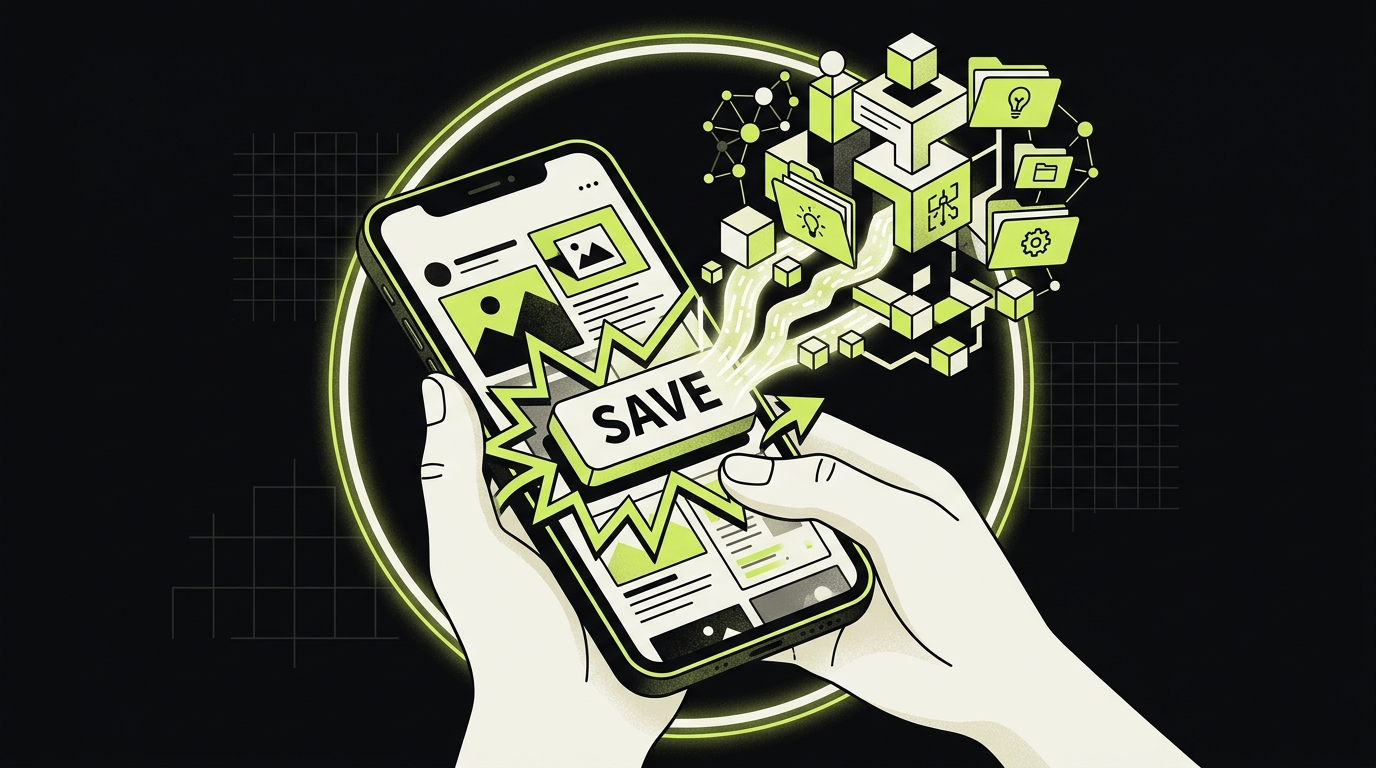
With Rtriv, supported social-media content or a web link can be shared through the iOS share sheet. The app centralizes saves in a searchable library and collections and, depending on the source, can extract a summary, transcript, ingredients or steps.
RTRIV also includes configurable attention controls. You can add friction or blocking rules before selected apps open, set daily intentions or quotas, and use reminders that point back toward an action. These controls are separate from the capture flow and can be adjusted by the user.
Rtriv also solves a workflow problem that most tools ignore: actually getting content out of social media apps and into a usable format. For a deeper look at how that works, see How to save content from social media: the complete guide.
If much of your useful information starts on social platforms, Rtriv covers a capture-and-action workflow that conventional note-taking apps often leave manual.
How to Choose the Right Personal Knowledge Base for Your Brain
The honest answer is that no single tool works for everyone. The right second brain app depends on three variables: where your content comes from, how you think, and how much time you're willing to invest in the system.
Match the Tool to Your Content Sources
If most of your valuable content comes from books and long articles, Readwise is hard to beat. If it comes from your own writing and thinking, Obsidian or Notion give you the structure to build on. If it comes from social media — which, for most people, it increasingly does — Rtriv addresses a gap the others don't.
Match the Tool to Your Cognitive Style
Some people think in hierarchies and love building databases. Others think in connections and want a graph. Others just want a clean inbox where things go in and come back out. Be honest about which of those describes you before committing to a tool built around a different model.
Match the Tool to Your Maintenance Tolerance
Every second brain app requires some maintenance. The question is how much. Notion and Obsidian reward high-maintenance users. Mem and Readwise work better for people who want the system to do more of the work. Rtriv sits in between: friction is built in to encourage engagement, but the system doesn't require elaborate curation to stay useful.
The best second brain apps make useful information retrievable at the moment of need. Measure success by whether the system supports a decision, project or action—not by the number of notes it contains.
Related reading :
Key Takeaways
- Fast capture is useful, but it needs reliable retrieval and review. A larger archive is not automatically a better second brain.
- The right personal knowledge base depends on where your content comes from: long-form reading (Readwise), structured thinking (Notion/Obsidian), or social media consumption (Rtriv).
- Rtriv is best understood as an action-oriented library for supported social-media content and web links, not a replacement for every note-taking workflow.
- AI features (Mem, Notion AI) are useful for text-heavy note-takers but don't solve the retention problem on their own. Intentional engagement still matters.
- Before choosing any external memory system, define your use case: capture, retention, or connection. Most tools only solve one of the three well.
Sources checked
Frequently Asked Questions
About
Équipe RTRIV
We design RTRIV to turn saved content into decisions, projects and moments that are actually lived.