8 Best TikTok Replacement Apps & Alternatives (2026)
Compare 8 TikTok alternatives for short video, creators, privacy and less scrolling—including Reels, Shorts, RedNote, Loops and Rtriv.
8 Best TikTok Replacement Apps and Alternatives in 2026
There is no exact TikTok replacement in 2026. Choose Instagram Reels for an existing social graph, YouTube Shorts for creator reach, RedNote or Lemon8 for visual discovery, Clapper for a smaller creator community, Loops for a federated open-social approach, or Rtriv if your real goal is to keep useful content while spending less time inside feeds.
TikTok alternatives at a glance
| Alternative | Best for | Similar to TikTok? | Important trade-off |
|---|---|---|---|
| Instagram Reels | Existing Instagram audience | High | Keeps an infinite recommendation feed |
| YouTube Shorts | Broad creator and search ecosystem | High | Shorts remains part of YouTube's feed system |
| Snapchat Spotlight | Snapchat-native social use | High | Best fit depends heavily on your existing network |
| RedNote | Lifestyle discovery and community | Medium | Different language, moderation and privacy context |
| Lemon8 | Visual lifestyle posts | Medium | Owned by ByteDance; not a privacy-led switch |
| Clapper | Smaller creator-led community | High | Far smaller audience than TikTok |
| Loops | Federated, open-social short video | Medium | Younger ecosystem and fewer creators |
| Rtriv | Keeping useful saves while reducing feed use | Low | Not a social network or video feed |
On This Page
- Why most tiktok alternative apps don't solve the real problem
- The most popular apps like tiktok compared
- What to actually look for when you replace tiktok
- Rtriv: an alternative to the feed
- Who each app is actually for
- Key Takeaways
- FAQ
Why Most TikTok Alternative Apps Don't Solve the Real Problem
If you're searching for a TikTok replacement app, you already know something is off. Maybe you've noticed an hour disappearing into a feed you never meant to open. Maybe you've tried deleting the app, only to reinstall it three days later out of habit.
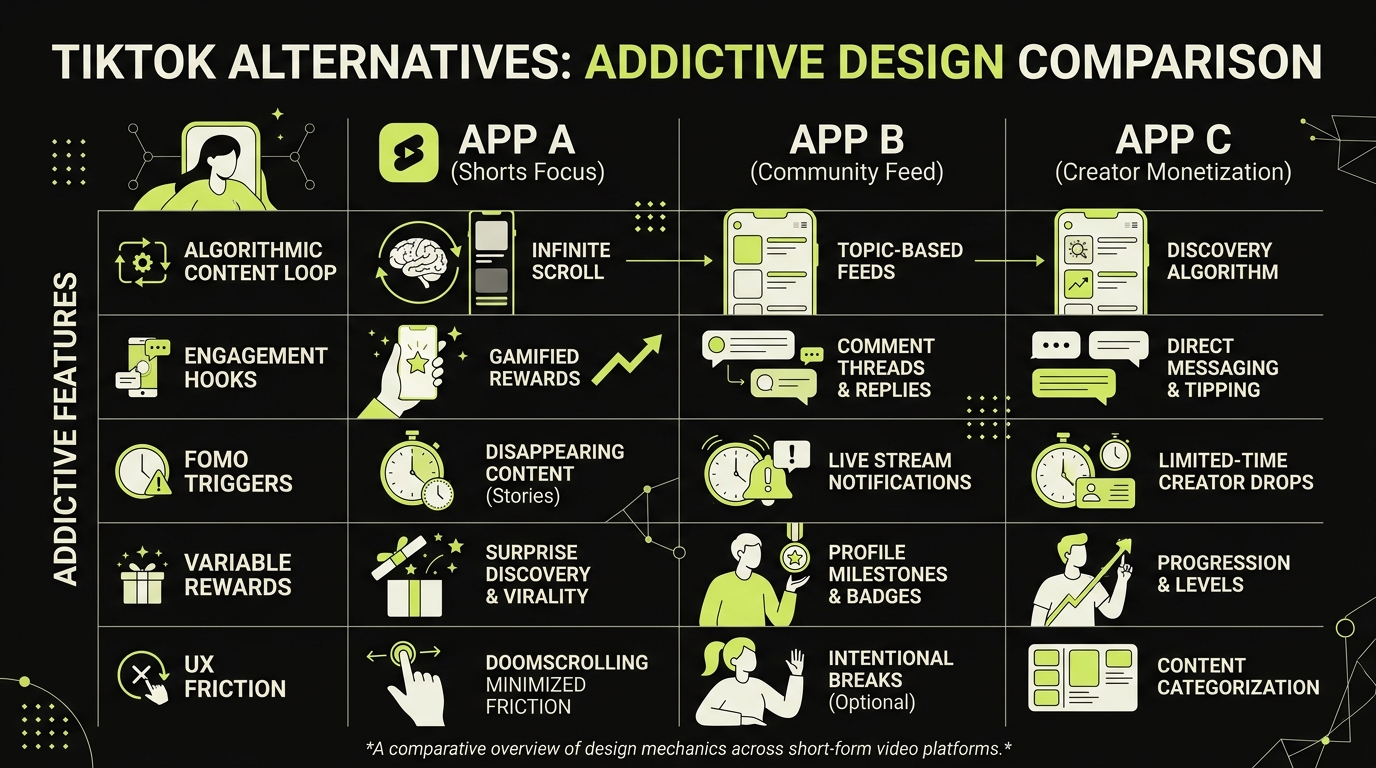
The impulse to find a TikTok substitute makes sense. But most of the apps marketed as alternatives don't actually fix anything. They replicate the same design: infinite scroll, autoplay video, algorithmic recommendation engines optimized for engagement above everything else.
The interface matters. Swapping TikTok for Instagram Reels or YouTube Shorts may preserve autoplay, continuous recommendations and few natural stopping points, even when the creators and topics change.
Understanding this changes how you evaluate any short video alternative. The question isn't "what looks like TikTok?" — it's "what breaks the loop?"
To go deeper on why scrolling feels impossible to stop, read our guide on what doomscrolling is and how to stop it.
The Most Popular Apps Like TikTok Compared
Let's look honestly at the most common TikTok replacements and what they actually offer.
Instagram Reels
Reels is the most seamless transition for existing Instagram users. The content format is nearly identical to TikTok, and the algorithm is similarly aggressive.
The upside: a huge content library, familiar creators, and integration with your existing social graph. The downside: Meta's engagement model is just as optimized for time-on-app as ByteDance's. You're not escaping the loop — you're entering a slightly different version of it.
YouTube Shorts
YouTube Shorts gives you access to the broadest creator ecosystem on the internet. For educational content especially, it can feel more substantive than TikTok.
But the Shorts feed is embedded inside YouTube's larger recommendation system and retains autoplay-style, continuous discovery. It may replace TikTok's creator ecosystem without changing the habit of watching one recommended clip after another.
Snapchat Spotlight
Spotlight is Snapchat's answer to the short-form video trend. It skews younger and emphasizes ephemeral, unpolished content.
It's a legitimate TikTok substitute for a specific audience, but its usage patterns mirror TikTok's closely. The Stories format encourages repeated check-ins throughout the day — a habit loop that's hard to break.
RedNote and Lemon8
RedNote combines short-form media, lifestyle discovery and search-like recommendations. Lemon8 emphasizes lifestyle posts and visual guides. Both can appeal to people who use TikTok for beauty, food, travel or product discovery rather than purely for entertainment.
They are not privacy-neutral replacements. Lemon8 is owned by ByteDance, and moving to any platform means reviewing its current data practices, moderation model and availability in your country.
Clapper and Loops
Clapper offers a smaller short-video and live-streaming community. Loops takes a different route through the fediverse and ActivityPub ecosystem. Both offer meaningful alternatives for specific users, but neither currently matches TikTok's audience, creator tools and recommendation scale.
For a broader look at tools that actually address the scrolling problem, our roundup of Best apps to replace doomscrolling goes further into the landscape.
What to Actually Look For When You Replace TikTok
Most comparison articles stop at content format and creator ecosystem. But if your goal is to reduce compulsive usage — not just swap one feed for another — you need a different evaluation framework.
Here are the three questions worth asking about any TikTok replacement app:
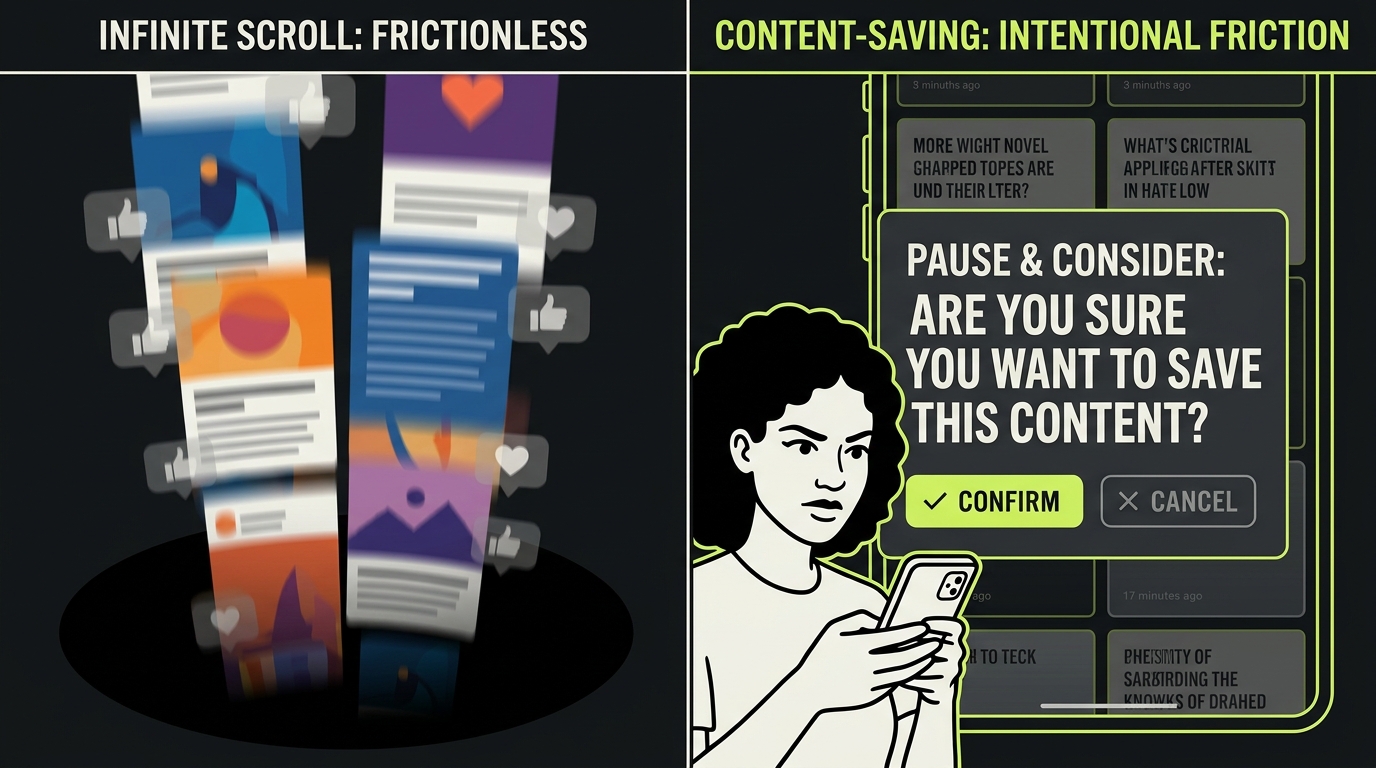
Does it use infinite scroll? Infinite scroll removes natural stopping points. The Behavioural Insights Team's discussion of online design explains how interface choices can shape behavior. Check whether the alternative gives you a natural end to a session or simply recreates the same loop.
Does it distinguish between saving and consuming? TikTok's "favorite" feature exists inside the feed — you still have to scroll to get to it. Apps that separate saving from browsing create a meaningful behavioral difference. You can act with intention rather than reflex.
Does it include stopping cues or controls? A timer, daily limit, scheduled block or prompt before opening can interrupt an automatic session. No single control works for everyone, so test whether it changes your actual behavior rather than assuming installation is enough.
These criteria shift the conversation from "what content can I watch?" to "what relationship does this app create with my attention?" That's the right question.
Rtriv: an alternative to the feed, not to TikTok's network
Rtriv does not replace TikTok's creators, comments, publishing tools or audience. It addresses a different reason people hesitate to leave: the useful posts they have saved or still encounter on social platforms.
Rather than building another feed, Rtriv accepts supported social-media and web links through the iOS share sheet. Depending on the source, it can organize extracted information such as a title, summary, transcript, ingredients or steps in a searchable library and collections. See the cross-platform saving workflow for when this is useful. It is not a universal video downloader.
Separately, Rtriv offers configurable attention controls: users can add friction or blocking rules before selected apps open and set daily intentions or quotas. This makes it possible to preserve useful content while changing access to the feed itself.
The result is an app that handles the legitimate use case — staying connected to content you love — without feeding the compulsive usage patterns that make TikTok feel impossible to quit.
For someone whose goal is less feed time, that creates a structural alternative: preserve the useful reference, then leave the recommendation loop. The effect still depends on the rules and habits the user chooses.
If you're looking for a fuller picture of tools with a similar philosophy, our guide to Best apps to replace doomscrolling covers the landscape in depth.
Who Each App Is Actually For
Choosing the right tool depends on what you're actually trying to solve.
Instagram Reels or YouTube Shorts make sense if you want to stay connected to creators you already follow and you're not concerned about usage patterns. They're the path of least resistance — familiar, content-rich, and socially integrated.
RedNote or Lemon8 may fit lifestyle discovery, but they are not equivalent choices for privacy, ownership or regional availability.
Snapchat Spotlight fits people whose friends and messaging already live on Snapchat. Clapper or Loops fit users willing to trade scale for a smaller or more open ecosystem.
Rtriv fits a different objective: keep useful information from supported posts without replacing TikTok with another entertainment feed. It is a companion for retrieval and action, not a destination for publishing or watching short videos.
If you've tried replacing TikTok with another app and found yourself equally hooked three weeks later, the issue isn't your willpower. It's that you were using the same tool with a different icon. Rtriv is built for a different goal.
Related reading :
Key Takeaways
- Most apps like TikTok replicate the same infinite scroll and algorithmic design — swapping platforms doesn't break the scroll loop.
- Evaluate any TikTok replacement app by whether it uses infinite scroll, separates saving from consuming, and introduces friction rather than removing it.
- Rtriv is not a TikTok-like network. It is an iPhone option for structured saves plus configurable controls around selected apps.
Sources checked
Frequently Asked Questions
About
Équipe RTRIV
We design RTRIV to turn saved content into decisions, projects and moments that are actually lived.