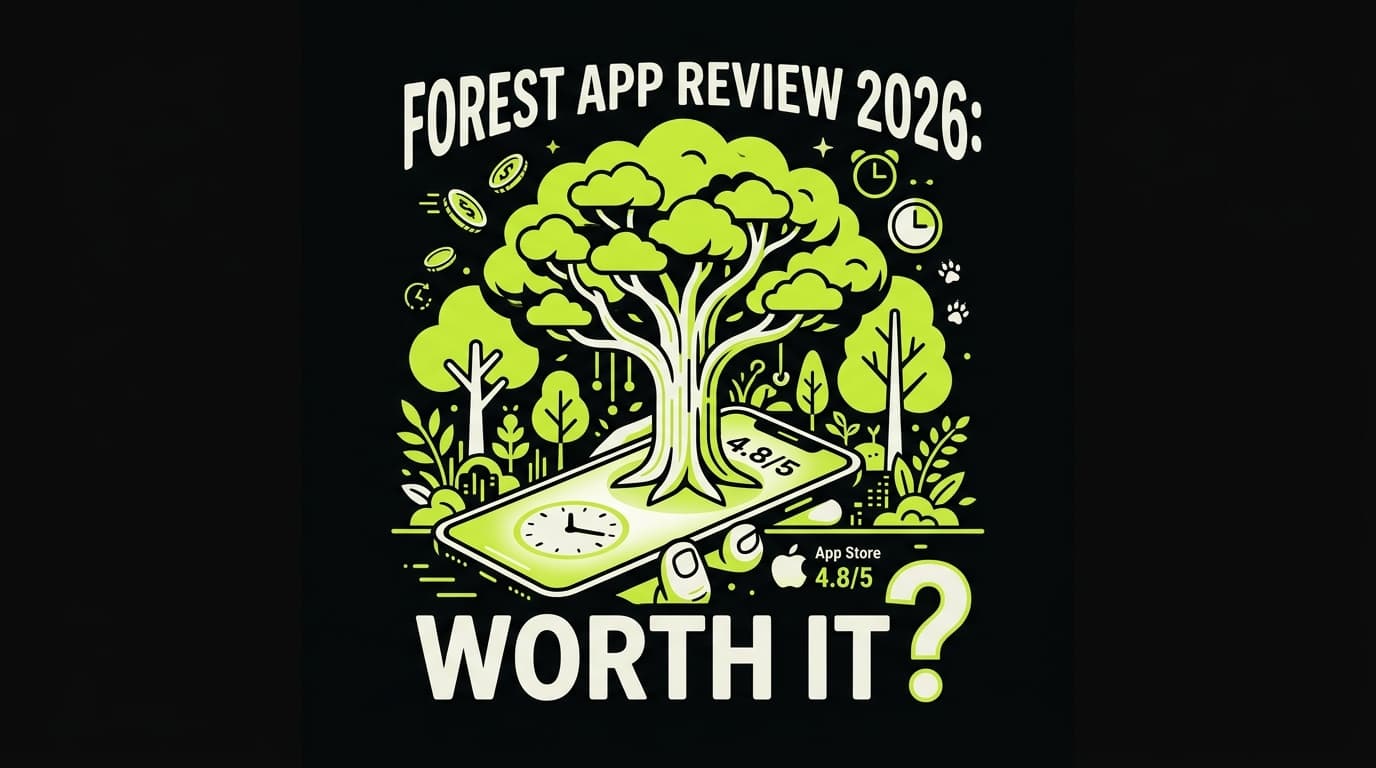
Forest App Review 2026: Is It Worth It?
Discover our honest Forest app review: features, real limits, and why Rtriv may be a smarter alternative for breaking phone addiction in 2026.
An Honest Forest App Review: What It Does Well (and Where It Falls Short)
This article gives you a complete, unbiased Forest app review — covering real strengths, real limitations, and which alternatives might actually serve you better depending on how you use your phone.
On This Page
- What is the Forest app and how does it work?
- Forest app review: the genuine strengths
- The real limits of the Forest focus timer
- Who should actually use Forest?
- Forest app alternatives worth considering in 2026
- Key Takeaways
- Frequently Asked Questions
What is the Forest app and how does it work?
If you've spent any time searching for a focus app, you've almost certainly come across Forest. The Forest app review conversation has been going on since the app launched in 2014, and for good reason — it was one of the first consumer apps to turn phone abstinence into a game.
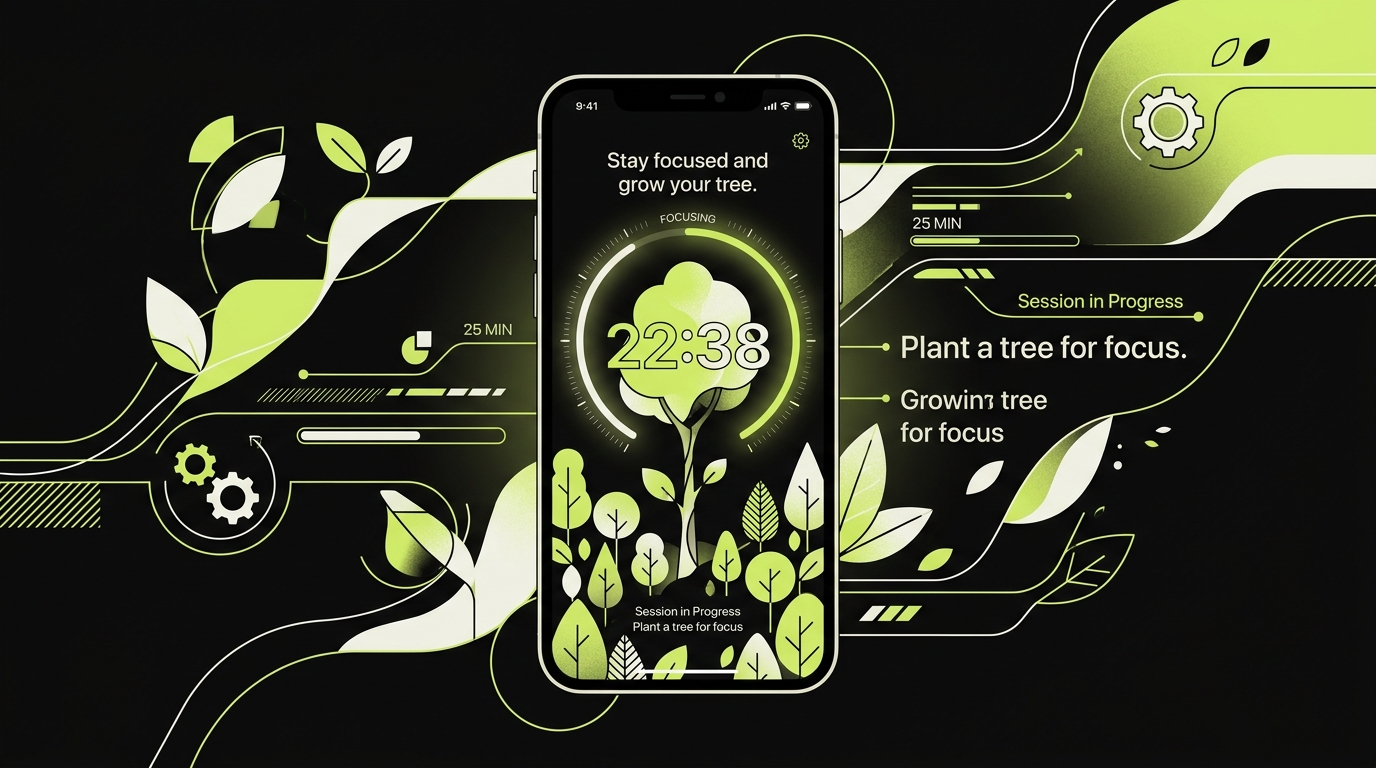
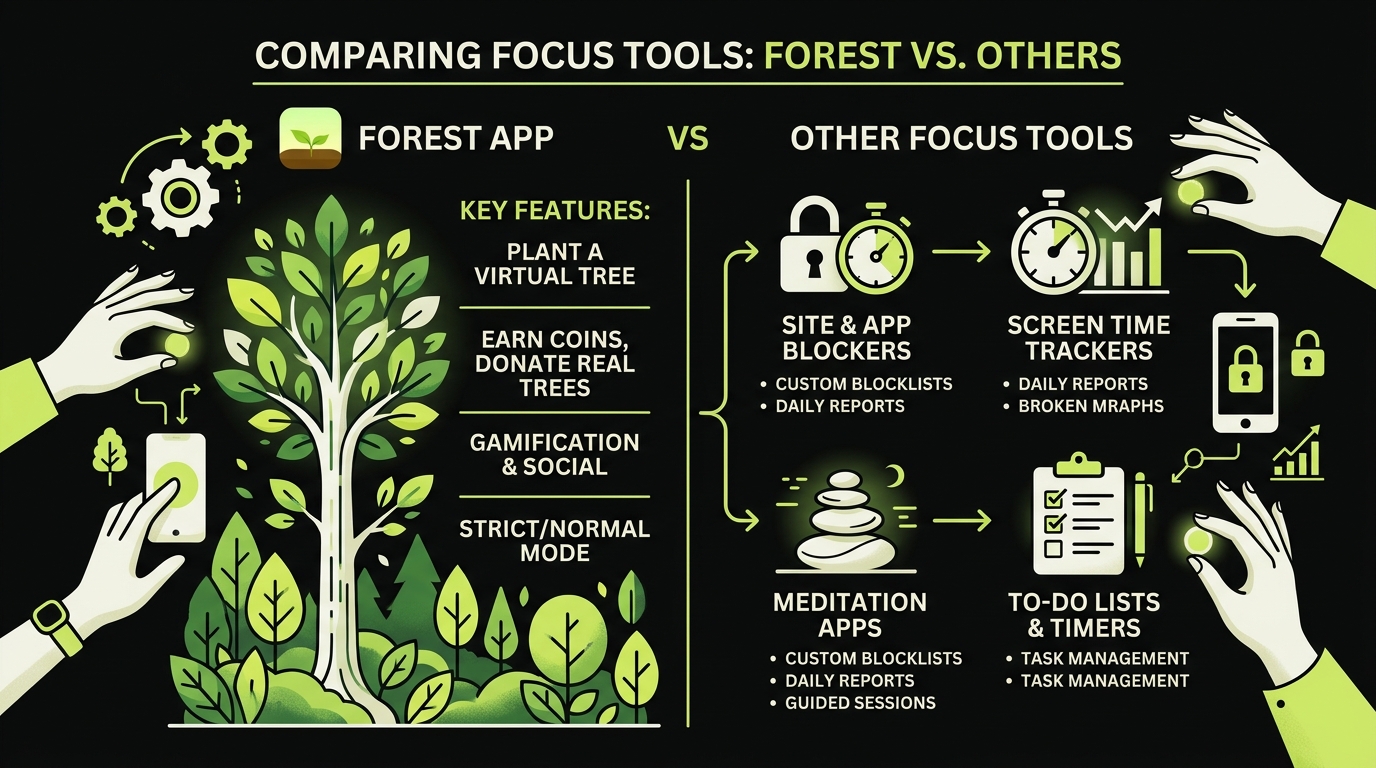
The premise is simple: you set a timer, plant a virtual tree, and if you leave the app before the timer ends, the tree dies. Stay focused and your tree grows. Over time, you build a forest of completed sessions. You can also spend earned coins to plant real trees through a partnership with Trees for the Future.
It's available on iOS and Android. The free version offers core features, while the premium tier ($1.99/month or a one-time purchase depending on platform) unlocks deeper customization, more tree species, and whitelist functionality.
The app draws heavily on the Pomodoro technique — structured work intervals followed by short breaks — which gives it a dual identity as both a gamified phone lock and a Forest Pomodoro app.
Forest app review: the genuine strengths
Let's be fair: Forest does several things very well, and dismissing it entirely would be intellectually dishonest.
Friction by design
The core mechanic works because it introduces what behavioral scientists call a "commitment device." By staking something emotionally meaningful — a living tree — against your impulse to check Instagram, Forest creates a micro-cost to distraction. That's psychologically sound.
Research published in Computers in Human Behavior has shown that gamification elements like visual progress, streaks, and symbolic rewards can meaningfully increase self-regulatory behavior around technology use, at least in the short term.
Visual motivation that actually lands
Most productivity apps are abstract. Forest is visceral. Watching a tree grow over 25 minutes activates a different kind of motivation than watching a progress bar fill. This matters for users who are more visually or emotionally driven — a significant share of the audience struggling with phone addiction.
The social and environmental layer
The real-tree planting feature gives Forest a rare sense of purpose beyond the self. Co-planting with friends adds mild accountability. These layers transform what could be a cold timer into something that feels meaningful — which extends retention and daily use.
It works as a Pomodoro app
For pure Pomodoro functionality, the Forest focus timer is genuinely solid. Customizable intervals, session tracking, and a clean interface make it a credible choice for students and professionals who want a structured work rhythm with a visual reward attached.
The real limits of the Forest focus timer
This is where an honest Forest review has to go somewhere most app-store write-ups won't.
It only addresses the symptom, not the trigger
Forest locks you out of other apps during a session. But it does nothing about why you opened your phone in the first place, or what happens the moment the timer ends. The compulsion to scroll didn't disappear — it was temporarily suppressed.
A 2023 study from University College London found that habitual social media checking is driven by variable reward schedules and emotional state regulation — not just lack of willpower or time management. An app that blocks your phone for 25 minutes doesn't rewire those underlying loops.
The guilt mechanic has a ceiling
Killing your virtual tree feels bad the first few times. After that? Many users report a kind of tolerance — the emotional sting fades, and the lock becomes easier to override. This is a known issue with commitment devices: their power erodes as novelty wears off.
Scroll through Reddit's r/nosurf or r/productivity and you'll find dozens of threads about this exact pattern — Forest working brilliantly for two weeks, then becoming easy to ignore.
It doesn't integrate with how you actually consume content
Modern phone addiction isn't just about "wasting time." It's about the content discovery loop — you open TikTok to save a recipe, stay for 40 minutes, close the app feeling vaguely terrible. Forest doesn't touch this. It has no mechanism for helping you interact with social media more intentionally. It simply tells you not to go there.
No content layer, no save mechanic
If you're a person who genuinely uses social media for discovery — finding articles, recipes, products, ideas — Forest offers no way to accommodate that. You're forced to choose between full abstinence during a session and full access with no guardrails. That binary is too crude for most real-world usage.
Who should actually use Forest?
Forest works best for a specific type of user: someone who needs a structured focus block with a visual reward, who is relatively early in their journey with digital wellness, and who isn't yet dealing with deep habitual scrolling loops.
Students cramming for exams, remote workers fighting afternoon slumps, and people who simply want a prettier Pomodoro timer — these users will get genuine value from Forest.
It's less effective for users who have already tried and burned through gamified tools, who use social media for legitimate curation purposes, or who recognize that their problem isn't "time spent on phone" but "the quality and intention of that time."
For the latter group, Forest app alternatives deserve serious consideration.
Forest app alternatives worth considering in 2026
If Forest isn't quite the right fit, you're not short of options. But most alternatives fall into the same category: blockers and timers. They treat screen time as the enemy and access restriction as the cure.
For a broader look at tools across this category, the guide on apps to replace doomscrolling breaks down the landscape well.
Screen time managers and blockers
Apps like iOS Screen Time or Freedom offer harder enforcement — scheduled blocks, passcode protection, app limits. If you need a more aggressive version of what Forest does, these are the next step up. But they share the same conceptual limit: they're reactive, not structural.
Rtriv: addressing the moment before the addiction
This is where Rtriv does something genuinely different — and it's worth explaining why.
Rtriv is an iOS app built around a single insight: the problem isn't that you use social media, it's that you use it mindlessly. The typical user opens Instagram to save a Reel, gets caught in the feed, and exits 45 minutes later having saved nothing and processed even less.
Rtriv adds intentional friction to the saving act itself. When you want to save a piece of content from social media, Rtriv asks you to engage with it — to tag it, categorize it, or reflect on why you're saving it. That moment of intentional pause is a pattern interrupt. It breaks the automatic loop before it fully starts.
This is a meaningful departure from the tree-growing productivity app model. Forest asks you to stay off your phone. Rtriv asks you to use your phone differently — more like a tool, less like a slot machine.
For people who use social media for genuine discovery and curation, Rtriv doesn't punish that behavior. It restructures it. The friction is the feature.
You can also explore Opal alternatives if you're specifically looking at blocker-first tools with a free tier.
Which approach is right for you?
The question isn't which app is "best" — it's which behavioral model matches your actual problem. If you need scheduled focus sessions with a visual reward: Forest. If you need harder enforcement: a blocker. If you need to reclaim intentionality around how you interact with content: Rtriv.
Many users find that combining tools works better than relying on a single one — using Rtriv during browsing sessions and a Pomodoro timer for deep work blocks.
Related reading :
- Freedom App Review 2026: Is It Worth It?
- Best TikTok Replacement Apps in 2026
- ScreenZen App Review: Is It Worth It in 2026?
Key Takeaways
- Forest is a genuinely solid Forest Pomodoro app with a smart gamified phone lock mechanic — but its emotional friction fades with use, and it doesn't address the root triggers of scrolling behavior.
- The tree-growing productivity app model works well for structured focus sessions, but falls short for users who need to reform how they interact with content, not just restrict access to it.
- Rtriv takes a different architectural approach: instead of blocking social media after the urge hits, it introduces intentional friction at the moment of saving — restructuring the habit loop before it deepens.
- No single app solves phone addiction. The most effective approach combines tools that match each layer of the problem: focus sessions, content intention, and behavioral pattern interruption.
Frequently Asked Questions
About
Équipe RTRIV
We design RTRIV to turn saved content into decisions, projects and moments that are actually lived.