ADHD and Phone Addiction: The Link and What Helps
ADHD can make phone habits harder to regulate—but dopamine myths obscure the real picture. Learn what research shows and build a practical plan.

ADHD and phone addiction: what the research shows—and what to do
You pick up your phone to check one message, lose 40 minutes, then struggle to restart the task you left. For some people with ADHD, that sequence is frequent and costly. It does not mean an “ADHD brain is addicted to dopamine,” and it does not prove a clinical addiction.
Research supports an association between ADHD symptoms and problematic digital-media use, but cause and effect are complex. This guide replaces the usual dopamine shortcuts with a practical system for reducing unwanted phone use.
Is “phone addiction” a diagnosis?
Researchers use terms such as problematic smartphone use to describe loss of control and negative consequences. There is no universally agreed definition or single diagnostic test for “phone addiction.” A high hour count alone is not enough.
Look instead for a repeated pattern:
- you use the phone longer than intended;
- attempts to cut back repeatedly fail;
- sleep, work, study, relationships or safety suffer;
- checking continues despite those consequences;
- the behavior causes distress or feels out of control.
This distinction prevents two errors: pathologizing every enthusiastic user and dismissing genuine impairment because the label is debated.
What ADHD changes
ADHD is a developmental disorder involving persistent inattention and/or hyperactivity-impulsivity that impairs functioning in multiple settings. It is not diagnosed from screen habits.
Several ADHD-related difficulties can make smartphones especially sticky:
Immediate rewards beat delayed tasks
A message, video or search produces a quick, concrete outcome. Starting paperwork or studying offers a delayed and uncertain reward. When task initiation is difficult, the phone becomes an easy transition away from discomfort.
Time becomes hard to track
Short-form feeds have few natural endings. If you already struggle to estimate elapsed time, “five minutes” can expand without a clear signal.
Interruptions are costly
A notification does more than consume the seconds used to check it. It also creates another task to remember and a return transition. Repeated switching can be particularly disruptive when working memory and task re-entry are already difficult.
The phone can regulate emotion or stimulation
Boredom, frustration and overwhelm may trigger checking. The feed offers novelty or temporary relief, but may leave the original task—and the emotion around it—unchanged.
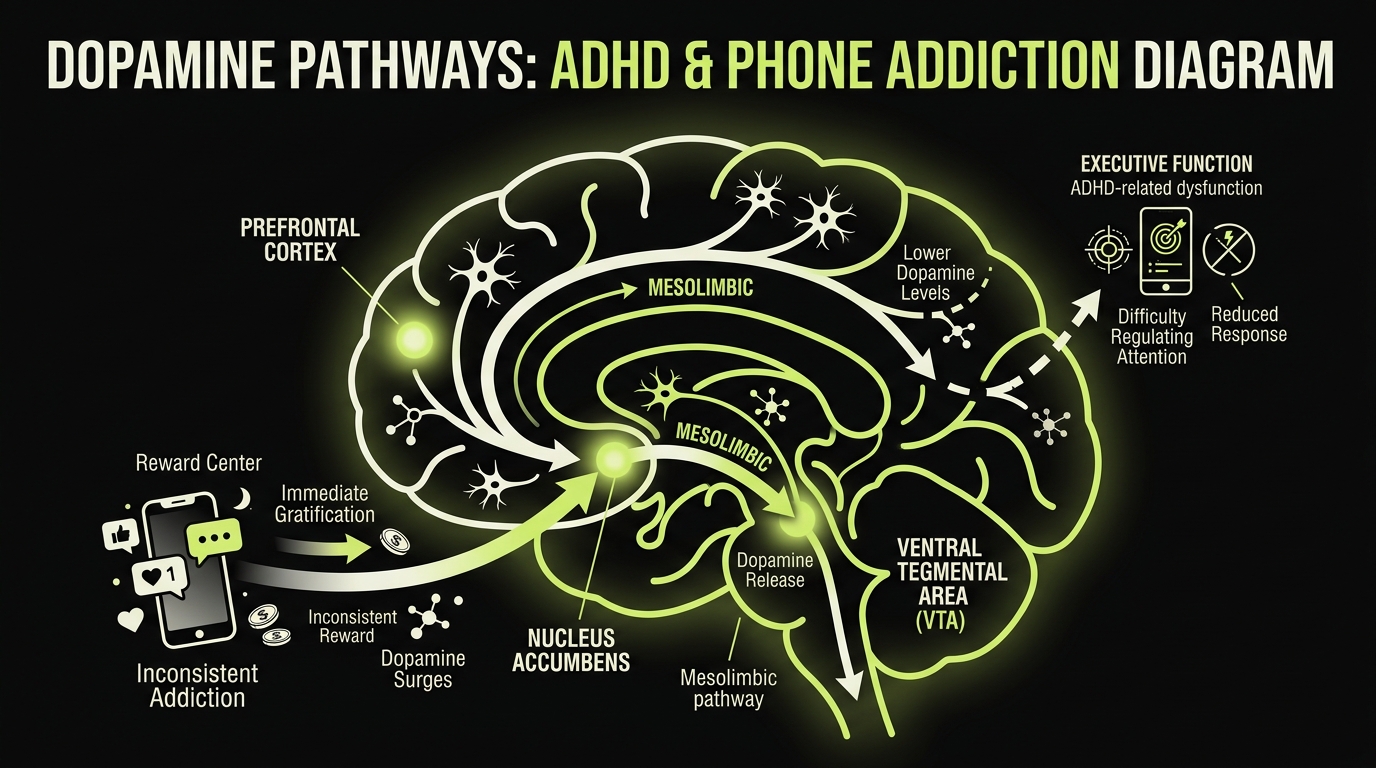
What the evidence does—and does not—prove
A meta-analysis found higher levels of problematic internet use among children and adolescents diagnosed with ADHD than in non-clinical controls, while noting substantial variation and limited study numbers. Another meta-analysis found associations between problematic internet use and inattention, hyperactivity and impulsivity, but cross-sectional evidence cannot establish direction.
A longitudinal review of children and adolescents found evidence for associations in both directions, generally small and more consistent for problematic use than raw screen time. The authors called for more work on mechanisms and moderators.
The defensible conclusion is that ADHD may increase vulnerability and unhealthy digital patterns may aggravate sleep or functioning. It is not defensible to say phones cause ADHD, that every person with ADHD lacks dopamine, or that one intervention works for all.
A phone plan designed for ADHD
1. Choose one costly situation
Do not target “less screen time.” Choose one observable problem: scrolling after lights-out, opening social media during work, or getting trapped after answering messages.
Write a replacement rule: When X happens, I will do Y. Example: “When I sit at my desk, the phone charges in the kitchen until the timer ends.”
2. Remove cues before relying on inhibition
- turn off non-human notifications;
- remove target apps from the first screen;
- keep the device outside arm’s reach during one task;
- use a watch or physical timer instead of checking the phone for time;
- sign out of the most automatic feed.
This reduces the number of decisions you must win in real time.
3. Make time visible
Set an external timer before opening a feed. Put the end time in writing or use a visible countdown. A vague intention to “stop soon” gives you no event to act on.
If the timer is always ignored, use Screen Time, one sec, ScreenZen, Jomo or another tool with stronger friction. Match the tool to the failure point: a pause for automatic opening, a session cap for failure to stop, or a strict block for protected work.
4. Build a low-effort alternative
The alternative must be available at the moment of temptation. Keep a short article queue, a notebook, water, a downloaded podcast or a two-minute physical task nearby. “Do something healthy” is too abstract for a difficult transition.
5. Separate saving from consuming
If useful posts keep you in the feed, share them to Rtriv and close the source. Rtriv can structure supported recipes, places and recommendations so they can be revisited away from the algorithm. It complements—but does not replace—a strict blocker.
6. Review the system weekly
Track only two measures: unwanted opens and whether the protected situation improved. If sleep remains poor, a smaller total screen-time number is not enough. If the rule fails, change the environment rather than adding shame.
Use the smallest effective barrier
Start with distance or a pause. Add a schedule, passcode or strict block only when lighter friction is repeatedly bypassed. Excessively complicated systems create their own executive-function burden.
Treatment and professional support
If you suspect ADHD, seek a qualified assessment. Diagnosis involves history, symptoms across settings and ruling out other explanations; a phone-use questionnaire is not sufficient.
Evidence-based ADHD treatment can include medication and psychotherapy or behavioral support. Treatment may improve the symptoms that contribute to unwanted checking, but clinicians do not prescribe ADHD medication as a standalone cure for phone use. Never start, stop or change medication without the prescriber.
Seek help when phone behavior is causing sustained impairment, severe sleep loss, dangerous use or significant distress. A clinician can assess ADHD, anxiety, depression, sleep problems and other overlapping factors. Our broader phone addiction treatment guide explains available support without promising a quick cure.
Sources
- NIMH — Attention-Deficit/Hyperactivity Disorder
- Systematic review of longitudinal digital-media and ADHD associations
- Meta-analysis of problematic digital-media use in youth with ADHD
- Meta-analysis of problematic internet use and ADHD-related symptoms
Key takeaways
- ADHD and problematic phone use are associated, but the relationship is complex and not a simple dopamine story.
- Target one costly situation, remove cues, make time visible and prepare a low-effort replacement.
- Heavy phone use cannot diagnose ADHD, and ADHD treatment should be managed with a qualified clinician.
Frequently asked questions
Why can phone use be harder to control with ADHD?
ADHD can involve impulsivity, time-management difficulty, distractibility and preference for immediate rewards. A phone combines instant access, novelty and few stopping cues. Experiences still differ from person to person.
Does heavy phone use mean I have ADHD?
No. ADHD requires a persistent pattern beginning in childhood, impairment in more than one setting and a professional assessment. Sleep problems, anxiety and many other factors can also affect attention.
Can ADHD medication fix compulsive phone use?
Medication can reduce ADHD symptoms for some people, but it is not a phone-addiction treatment. Discuss benefits and side effects with the prescriber and never change a dose on your own.
Frequently Asked Questions
About
Équipe RTRIV
We design RTRIV to turn saved content into decisions, projects and moments that are actually lived.